Slow Fire, Sharp Knife: How Japanese Culinary Rituals Are Redefining Wellness in American Kitchens
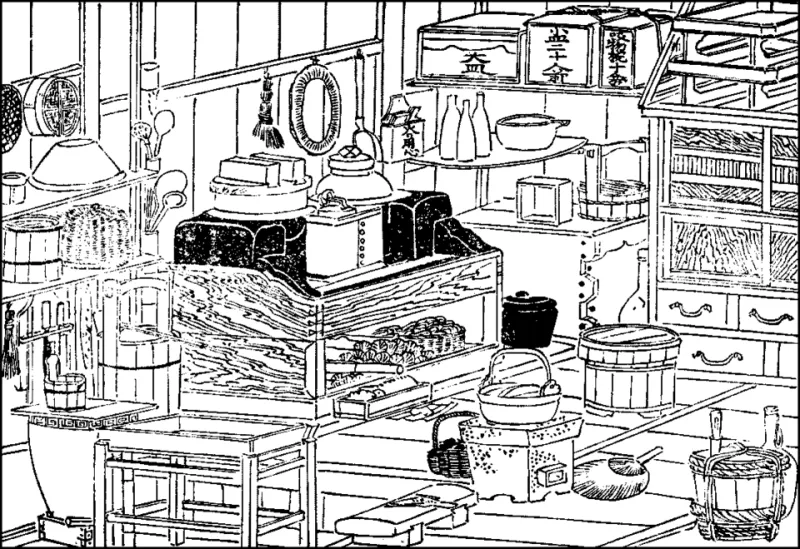
Photo: Unknown authorUnknown author, Public domain, via Wikimedia Commons
In a modest apartment kitchen in Portland, Oregon, Elena Vasquez rises forty minutes earlier than she once did—not to scroll her phone or squeeze in a workout, but to prepare miso soup. The ritual is deliberate: she soaks dried wakame the night before, shaves katsuobushi into thin curls by hand, and brings the dashi to temperature with patient attention. She does not rush. She does not multitask. "It changed what mornings mean to me," she says. "I'm not just feeding myself. I'm doing something that actually requires me to be present."
Vasquez is among a growing number of American home cooks who have turned to Japanese culinary philosophy not as a dietary trend, but as a framework for living more intentionally. At a moment when fast-casual dining dominates the cultural landscape and meal-prep culture prizes efficiency above all else, the principles embedded in Japanese home cooking—shun (seasonality), mottainai (the ethic of zero waste), and the meditative discipline of technique—are resonating with Americans who feel increasingly disconnected from what they eat and why.
The Philosophy Before the Recipe
To understand why Japanese culinary traditions are finding purchase in American wellness culture, one must look beyond the food itself. Japanese home cooking, particularly in its traditional expression, is inseparable from a broader sensibility about time, nature, and human attention. The concept of ichiju sansai—one soup, three sides—is not merely a structural guideline for a balanced meal. It is an architectural philosophy: a way of composing nourishment that honors restraint, balance, and the inherent quality of each ingredient.
Food educator and Japanese-American culinary instructor Naomi Fujita, who teaches workshops in Chicago under the name Shoku no Ma (The Space Between Bites), explains it this way: "In Japanese cooking tradition, the cook's job is largely to get out of the way of the ingredient. You are not imposing flavor so much as you are revealing it. That requires a completely different relationship with your kitchen—and with your own ego."
Fujita's workshops, which began as small gatherings for Japanese-American community members seeking to reconnect with their heritage, now draw a predominantly non-Japanese audience of professionals, parents, and wellness seekers. The demand, she notes, surprised her. "People are exhausted by optimization culture. They want something that slows them down, not speeds them up."
Knife Work as Moving Meditation
If there is a single skill that emblematizes the meditative dimension of Japanese cooking for American practitioners, it is knife technique. The Japanese kitchen knife—whether a gyuto, a nakiri, or the iconic yanagiba—is not merely a tool. It is the subject of generational knowledge, regional craft tradition, and philosophical attention.
In cities like San Francisco, Seattle, and New York, Japanese knife-skills workshops have seen enrollment surge over the past several years. These sessions rarely focus solely on technique. Instructors frequently incorporate the cultural context of knife-making traditions—the relationship between a blade and its maker, the discipline of maintenance, the respect owed to an instrument that has been shaped by human hands over many hours.
Marcos Delgado, a former software engineer in Austin who now leads community cooking classes, describes learning Japanese knife technique as a turning point in his relationship with food. "There's a reason they call it kireru—the quality of sharpness—and treat it almost spiritually. When your knife is right and your motion is right, the vegetable almost opens itself. It sounds strange, but it's the closest I've come to what people describe as flow state."
The physical discipline of proper knife work—posture, grip, breath, rhythm—maps closely onto practices Americans already associate with mindfulness traditions. It is no coincidence that many who arrive at Japanese culinary philosophy have backgrounds in yoga, martial arts, or contemplative practice.
Eating with the Season
Perhaps the most culturally significant aspect of Japanese cooking philosophy for an American audience is the concept of shun: the idea that ingredients possess a peak moment of vitality, and that cooking in alignment with that moment is both an aesthetic and an ethical act. In Japan, shun is not a niche concern for food purists—it is woven into the ordinary language of eating, reflected in restaurant menus that change not just seasonally but sometimes weekly.
For Americans navigating a food system in which strawberries appear in January and tomatoes are available year-round at a cost to flavor and ecology, the shun philosophy offers both a corrective and a revelation. Food scholars have noted that the concept resonates particularly strongly with Americans who are already engaged with local farming movements, community-supported agriculture, and environmental consciousness.
"When I started cooking with shun in mind, I stopped being frustrated by what wasn't available," says Anita Chowdhury, a home cook and food blogger based in Minneapolis who documents her practice online. "I started being excited by what was. That's a profound shift. It's almost grief work—learning to let go of wanting what isn't here yet."
Chowdhury notes that she encountered the concept not through a Japanese cooking class, but through reading about kaiseki, the formal multi-course cuisine that represents one of Japan's highest culinary art forms. The principles, she found, translated readily to her own modest, everyday kitchen.
Beyond Trend: The Question of Depth
Not everyone in the Japanese culinary community views this growing American interest with uncomplicated enthusiasm. Some Japanese and Japanese-American food professionals express concern that the wellness industry's tendency to extract and repackage cultural practices may flatten the complexity of what it borrows. When miso soup becomes a "gut-health hack" or knife sharpening is marketed as "stress relief," something essential may be lost in translation.
Fujita acknowledges the tension directly. "I welcome anyone who wants to learn. But I also think there's a responsibility to teach the whole context—not just the technique, but the tradition it comes from, the people who developed it, the values it embodies. Otherwise, you have the form without the spirit."
This is, perhaps, the most instructive lesson Japanese culinary tradition has to offer American wellness culture: that genuine transformation requires more than the adoption of a practice. It requires an encounter with the worldview that gave that practice meaning in the first place.
A Different Kind of Nourishment
The American kitchen has always been a site of cultural negotiation—a place where immigrant traditions meet new circumstances, where identity is preserved and reinvented simultaneously. What is notable about the current wave of interest in Japanese culinary philosophy is not that it is happening, but the depth at which it appears to be taking root.
For practitioners like Vasquez, Delgado, and Chowdhury, this is not a phase or a diet. It is, in the fullest sense of the word, a practice—one that asks something of the cook before it offers anything in return. In a culture that has largely optimized the act of eating into a logistical problem to be solved, that asking may be exactly the point.