Blue Runs Deep: American Textile Artists and the Ancient Call of Japanese Indigo
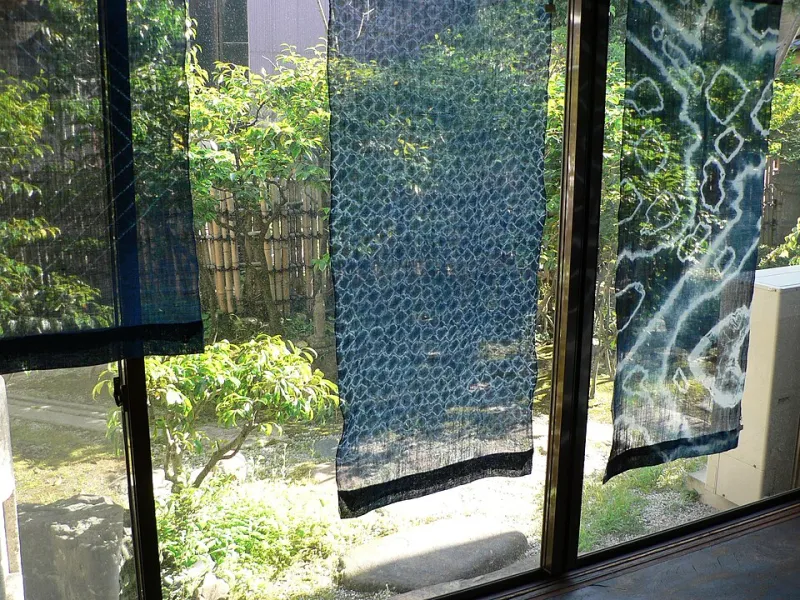
Photo: Katie, CC BY-SA 2.0, via Wikimedia Commons
There is a moment, every practitioner describes it in nearly identical terms, when a length of fabric is lifted from a fermentation vat and the color shifts. What emerges a dull, swampy green meets the air and blooms into a vivid, unmistakable blue. For Japanese artisans, this transformation has carried spiritual and aesthetic weight for over a thousand years. For a growing number of American textile artists, witnessing it for the first time is, as one Brooklyn-based maker put it, "the moment you stop being a hobbyist."
Across the United States, a quiet but determined revival is taking shape in converted garages, rented studio spaces, and community workshops. American craftspeople are studying the intertwined arts of aizome — traditional Japanese indigo dyeing — and shibori, the sophisticated resist-dyeing technique that produces patterns ranging from delicate ripples to bold geometric forms. What draws them is not merely aesthetic. It is the discipline, the philosophy, and the profound material intimacy these practices demand.
The Long Apprenticeship
For many American practitioners, the path begins with books and online communities, but it rarely ends there. Several have made extended journeys to Japan to study under working masters, navigating the formal apprenticeship culture that governs traditional craft transmission.
Sarah Kendall, a fiber artist based in Asheville, North Carolina, spent three months in Tokushima Prefecture — Japan's historic heartland of indigo cultivation — working alongside a third-generation ai-shi, or indigo farmer and dyer. "The technical knowledge is only part of it," she explains. "What you're really absorbing is an entire relationship with a plant, with time, with imperfection. The Japanese concept of ma — negative space, interval — is built into the process itself. You can't rush a fermentation vat."
Others have pursued independent mastery through intensive workshops hosted by organizations such as the Japan Society in New York or through dedicated craft residencies. The Slow Fiber Studios network, which maintains ties with Japanese textile communities, has become a notable bridge for American artists seeking structured pathways into these traditions.
What the Vat Requires
Authentic aizome begins not with dye powder but with sukumo — a composted indigo leaf preparation that takes weeks to produce and forms the biological heart of a living fermentation vat. Sourcing this material in the United States presents one of the most significant challenges practitioners face.
While domestic indigo (Indigofera tinctoria and native Persicaria tinctoria) can be grown across much of the American South and Pacific Northwest, producing sukumo requires specific knowledge, controlled composting conditions, and considerable patience. A small but dedicated network of American growers — concentrated in states such as Tennessee, California, and Oregon — has emerged to meet this need, often collaborating directly with Japanese agricultural communities to ensure the integrity of their methods.
Marcus Webb, who runs a natural dye studio in Portland, Oregon, spent two years perfecting his own sukumo production before he felt confident offering workshops. "People arrive expecting to make beautiful things immediately," he says with measured humor. "I tell them we're going to spend the first day talking about bacteria."
Beyond the vat itself, shibori's physical demands are considerable. The technique encompasses dozens of distinct methods — itajime (clamped resist), arashi (pole-wrapping), kumo (pleating and binding) — each requiring precise manipulation of fabric before it ever touches dye. The tools are minimal: poles, clamps, thread, and hands. The knowledge, however, is vast.
Adaptation Without Appropriation
The question of cultural authenticity surfaces in nearly every conversation within this community, and American practitioners tend to approach it with unusual candor. The distinction between cultural appreciation and cultural appropriation is one they navigate deliberately, often in public dialogue with their audiences and with Japanese collaborators.
Kendall's approach is characteristic of the broader ethos: she teaches the historical and cultural context of every technique she introduces, credits her Japanese teachers explicitly, and avoids marketing language that frames these traditions as her own innovations. "I am a student of this tradition," she states plainly on her studio's website. "I am not its author."
At the same time, practitioners acknowledge that living traditions evolve through contact and exchange. Contemporary American shibori work has found expression in fashion, home textiles, and fine art installations that would be unrecognizable to a Meiji-era dyer — and that is not inherently a problem. Several American artists have developed collaborative relationships with Japanese counterparts that both parties describe as mutually enriching, with American experimentalism occasionally prompting Japanese masters to revisit assumptions within their own practice.
From Studio to Market
The commercial landscape for American indigo and shibori work has expanded considerably over the past decade. Independent craft markets, Etsy storefronts, and boutique fashion labels have created genuine demand for handcrafted textiles produced through these methods. Buyers, particularly in urban markets, are increasingly willing to pay premium prices for goods whose provenance and process are clearly documented.
Webb's studio sells indigo-dyed linen napkins, wall hangings, and apparel through a combination of his own website and select retail partnerships in the Pacific Northwest. He notes that transparency about process — including the months required to prepare a vat and the inherent variability of natural dyeing — has become a marketing asset rather than a liability. "Customers want to know the story," he observes. "They want to understand why no two pieces are identical. That used to require explanation. Now people come in already knowing."
For Kendall, the commercial dimension remains secondary to the educational mission. She runs workshops from her Asheville studio and offers an annual intensive for serious practitioners, drawing participants from as far as Seattle and Boston. Her waiting list, she notes with quiet satisfaction, has grown every year.
A Living Thread
What the American indigo community ultimately represents is something Kougeisai has observed across many domains of Japanese cultural transmission: the recognition that living traditions survive not through preservation in amber, but through continued practice by people who understand what they carry. The vat must be fed. The cloth must be touched. The knowledge must move between hands.
The American practitioners working within these traditions are not claiming ownership of something that is not theirs. They are, rather, accepting a particular kind of responsibility — to learn carefully, teach honestly, and keep the blue alive.