The Unseen Hands: Craftspeople Who Build the World of Classical Japanese Theater
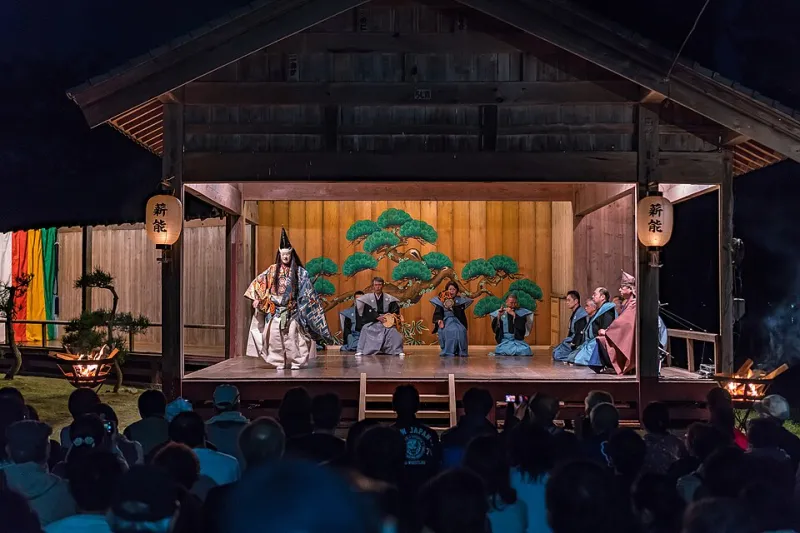
Photo: Yoshiyuki Ito, CC BY-SA 3.0, via Wikimedia Commons
When a Noh actor steps onto the hashigakari — the narrow bridgeway connecting the backstage world to the main performance space — the audience sees a figure from another realm. The mask conceals the human face entirely. The layered robes move with a weight and texture that no modern fabric can replicate. The fan, held at a precise angle, carries centuries of codified meaning. What the audience rarely considers, and what the program notes almost never mention, is that each of these objects was made by a different specialist, trained for years or decades in a craft so narrow it may be practiced by fewer than a dozen living people.
Classical Japanese theater — encompassing Noh, Kyogen, Kabuki, and Bunraku puppet theater — is sustained not only by its performers but by an intricate ecosystem of artisans whose work is as rigorously disciplined as any performance tradition. These are the mask carvers, the kimono embroiderers, the wig makers, the lacquerers, the prop builders, and the weavers whose combined output constitutes the material world of the stage.
The Mask Carver's Inheritance
Of all the crafts that support classical theater, Noh mask carving (omote-shi) may be the most demanding and the most philosophically weighted. A finished Noh mask is not merely a prop; it is understood, within the tradition, as a vessel capable of expressing emotion through the interaction of light, angle, and the performer's own physical intention. The carver's task is to create an object that appears to shift expression without moving — serene when the actor tilts the face downward, anguished when it rises toward the light.
Masters such as Nagasawa Ujiharu, whose family has worked in mask carving for four generations, describe the craft as one of perpetual apprenticeship. The traditional training period extends for a minimum of ten years, during which a student progresses from learning to sharpen and maintain tools through carving practice pieces, before ever being permitted to work on a mask intended for performance use.
The tools themselves — a set of specialized chisels and gouges that a carver may spend years assembling — are often inherited or commissioned from dedicated blacksmiths who understand the specific requirements of the work. The wood of choice is hinoki cypress, prized for its fine grain, workability, and the subtle warmth it lends to the finished surface. After carving, masks are primed, painted in multiple layers, and finished with techniques that have remained largely unchanged since the Muromachi period.
The Embroiderer's Geometry
Kabuki costuming operates at a different scale entirely. Where Noh achieves its effect through stillness and suggestion, Kabuki embraces spectacle — and the textiles that serve this theater must be visually legible from the back row of a large house. The embroiderers and weavers who produce Kabuki kimono work within a tradition of deliberate excess, producing garments whose surface decoration may represent hundreds of hours of hand labor.
Nishijin weaving, centered in Kyoto's historic textile district, has supplied Kabuki houses with their most prestigious fabrics for centuries. The complex nishiki brocades produced on Nishijin looms — some of which are still Jacquard-card-operated mechanical devices dating to the nineteenth century — incorporate silk, metallic thread, and dyes whose formulations are closely guarded within weaving families.
Embroidery specialists work separately from weavers, adding dimensional elements — raised nui work, couched gold thread, padded forms — that give Kabuki costume its characteristic visual density. A single outer robe for a major Kabuki role may incorporate the work of multiple specialists across different studios, coordinated by a master costumer who holds the overall vision.
Tools of Illusion: Props and Set Construction
The prop makers and set builders who serve classical theater occupy a craft category that Western audiences might find surprising in its specificity. In Japan's major Kabuki theaters, dedicated workshops maintain the physical infrastructure of productions that have been in continuous repertoire for two centuries or more. A prop used in a current production of Kanadehon Chushingura may be a faithful reproduction of an object built for a staging in the 1880s, constructed using documented period methods.
This fidelity to historical specification is not mere conservatism. It reflects the understanding that classical theater is a total aesthetic system, in which every visual element has been calibrated in relation to every other. A prop whose proportions or finish diverges from tradition disrupts a visual grammar that audiences — particularly the deeply knowledgeable audiences who attend Kabuki regularly — read with considerable precision.
Lacquerwork, metalwork, and specialized paper construction are among the primary disciplines employed in prop making. The harimiko technique, in which paper is layered and shaped over molds to create lightweight but convincingly solid objects, is particularly prevalent in Noh and Kyogen, where actors must manipulate props with physical ease while maintaining the extreme precision of movement the forms demand.
American Stages and the Question of Supply
As classical Japanese theater has found audiences in the United States — through touring productions, university programs, and dedicated companies such as the Theatre of Yugen in San Francisco — American producers have confronted the material challenges of mounting these forms outside Japan.
The supply of authentic materials and qualified craftspeople does not travel easily. Masks and major costume pieces are typically imported from Japan, often through established relationships with specific workshops. However, the ongoing maintenance of these objects — repairs to masks, restoration of damaged embroidery, replacement of worn structural elements in costumes — requires local expertise that is only beginning to develop in the United States.
The Theatre of Yugen, which has produced Noh and Kyogen in the Bay Area for over four decades, has cultivated relationships with Japanese craftspeople who periodically travel to the United States for restoration work and, increasingly, for teaching. Artistic director Jubilith Moore has spoken publicly about the institution's commitment to training American artisans in the specific maintenance needs of classical theater objects — a form of cultural stewardship that extends beyond performance into material care.
Several American universities with strong Japanese studies or theater programs have begun incorporating craft training into their curricula, recognizing that the performance traditions they teach cannot be fully sustained without attention to the objects those performances require.
Passing the Chisel
The transmission of these craft traditions faces pressures familiar from many domains of specialized artisanal knowledge: aging master populations, economically challenging training pathways, and the difficulty of communicating to younger generations the value of work that is, by design, invisible to audiences.
In Japan, the Agency for Cultural Affairs designates certain practitioners as holders of Important Intangible Cultural Properties — the popular designation Ningen Kokuho, or Living National Treasure — in part to ensure that their knowledge is formally transmitted before it is lost. Several craftspeople who work in theatrical support roles hold this designation, a recognition that their contribution to Japan's performing arts is inseparable from the performances themselves.
For American audiences and institutions, the lesson may be this: to truly support classical Japanese theater is to support the full chain of human skill that makes it possible. The performer on stage is the visible culmination of a process that begins in a workshop, at a bench, in hands that have spent years learning to make objects worthy of a tradition that has endured for centuries.
Those hands deserve to be seen.