The Language of Stone and Silence: Why American Communities Are Turning to Japanese Garden Design as a Practice of Presence
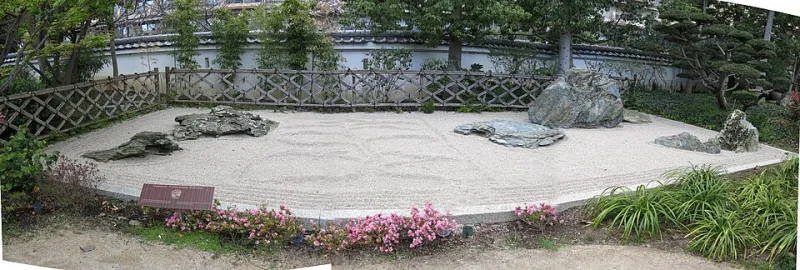
Photo: Tangopaso, Public domain, via Wikimedia Commons
Ken Sakamoto has been placing stones for thirty-one years. Not arranging them, he is careful to clarify — placing them. The distinction matters enormously to him. Arrangement implies the imposition of a human preference onto inert material. Placement, as Sakamoto understands it, is something closer to listening. "A stone has a face," he says, standing at the edge of a dry garden he is constructing for a contemplative retreat center in rural New Mexico. "It has a direction it wants to face, a weight it wants to rest on. My job is to find that, not to decide it."
Sakamoto is one of a small but growing number of artisans in the United States who specialize in the design and construction of authentic Japanese gardens — nihon teien — for American clients. His commissions have included private residences in Connecticut and Colorado, a meditation courtyard at a university in Minnesota, and a karesansui (dry landscape) garden at a Zen center in Northern California. Each project, he says, begins not with a design document but with a period of observation: of the land, of the light at different hours, of the way water — even imagined water — might move through the space.
More Than Aesthetics: The Philosophy Embedded in Every Element
To encounter a Japanese garden as purely a visual experience is to miss most of what it is doing. The tradition of Japanese garden design, which draws from Shinto reverence for natural forms, Buddhist principles of impermanence, and Taoist concepts of natural flow, is one of the most philosophically dense art forms in the world. Every element — the placement of rocks, the choice of moss over grass, the angle of a stone lantern, the borrowed view of a distant hillside — carries symbolic weight and is intended to guide the visitor through a series of emotional and contemplative states.
The concept of ma, or negative space, is as central to garden design as it is to Japanese calligraphy or theater. A garden is not defined only by what is placed within it, but by the relationships between elements and the silences between them. A single stone set in a field of raked gravel does not simply occupy space — it creates space, defining the emptiness around it and inviting the viewer's attention to rest in that emptiness.
Miegakure, or "hide and reveal," is another foundational principle. A well-designed Japanese garden never presents itself all at once. Paths curve. Plantings obscure sightlines. A stone bridge appears only as you round a bend. This sequential unfolding is deliberate: the garden teaches the visitor to slow down, to be present to the immediate moment rather than scanning ahead for the destination. For many Americans encountering this design language for the first time, the experience can be unexpectedly disorienting — and then, unexpectedly moving.
An American Appetite for Intentional Space
The growing American interest in Japanese garden design is not occurring in a cultural vacuum. It reflects a broader social turn toward practices of mindfulness and intentional living that has accelerated significantly over the past decade. Meditation apps, forest bathing programs, and therapeutic garden initiatives have all gained mainstream traction as responses to the documented psychological costs of screen saturation, urban density, and chronic busyness. Japanese garden design, with its millennia of accumulated wisdom about how physical environments shape interior states, arrives in this moment with unusual authority.
Dr. Patricia Wren, a landscape architect and professor at the University of Washington who has written extensively on Japanese garden principles, observes that her students increasingly arrive already drawn to the tradition. "They've often encountered it through a wellness context first — through a visit to a public Japanese garden, or through reading about Zen practice," she notes. "What surprises them is how technically rigorous the tradition is. This is not decorative landscaping. It is a complete design philosophy with its own spatial grammar, its own theory of time, its own understanding of what a human being needs from the spaces they inhabit."
Public Japanese gardens in the United States — including the celebrated Portland Japanese Garden in Oregon, the Shofuso Japanese House and Garden in Philadelphia, and the Anderson Japanese Gardens in Rockford, Illinois — have seen consistent growth in visitorship over the past several years, with many reporting record attendance. For some visitors, these public spaces serve as an introduction that eventually leads to commissioning private gardens of their own.
The Artisan's Long Education
Building an authentic Japanese garden in America is not a project that can be undertaken casually. The most respected practitioners in the field have typically spent years studying in Japan, often apprenticing under master garden designers (niwashi) in Kyoto or Kanazawa, where the tradition has been maintained in unbroken lineage for centuries. The apprenticeship model — learning by doing, under close supervision, with an emphasis on absorbing principles rather than copying forms — is itself a reflection of the broader Japanese craft philosophy that Kougeisai has long celebrated.
Maria Espinoza, a garden designer based in Santa Fe who trained for four years under a niwashi in Kyoto, describes the learning process as one of progressive humility. "The first year, you think you understand what a Japanese garden is," she says. "By the fourth year, you understand that you are only beginning to understand. The tradition is deep enough that it will take a lifetime to learn, and that is not a discouraging thing — it is the point."
Espinoza's American commissions are notable for their sensitivity to regional ecology. She does not import Japanese plant species wholesale into desert or prairie environments; instead, she studies the design principles carefully and seeks native or regionally appropriate plants that carry equivalent visual and symbolic qualities. A native juniper may stand in for a Japanese black pine. Local basalt may be used in place of Kyoto's volcanic rock. The result is a garden that is authentically Japanese in spirit and spatial logic, while being genuinely of the place where it grows.
A Garden That Is Never Finished
Perhaps the most important thing to understand about a Japanese garden, for the American homeowner or community organization considering one, is that it is not a project with a completion date. It is a living system that changes with every season, every rainfall, every decade of a tree's growth. The moss that covers a stone after five years of careful maintenance is not an afterthought — it is the garden becoming itself. The artisans who build these spaces speak of them with the affection of ongoing relationships rather than completed works.
This temporal dimension is, for many clients, the most transformative aspect of the experience. In a culture that prizes efficiency and finished products, a garden that requires patient, attentive maintenance across years and decades asks something genuinely countercultural of its owner. It asks for presence. It asks for the willingness to show up, season after season, and simply look — at the stone, at the moss, at the raked gravel that will be disturbed by tomorrow's rain and raked again.
Ken Sakamoto, still listening to his stone in the New Mexico afternoon light, puts it simply: "The garden teaches you how to be in a place. And once you know how to be in a place, you start to know how to be in your life."