Chambers of Quiet: What Japanese Tea House Acoustics Reveal About the Architecture of Meaningful Conversation
There is a particular quality of silence inside a traditional Japanese tea house that visitors often struggle to name. It is not the absence of sound so much as the presence of something else — a calibrated stillness that makes the rustle of a kimono sleeve or the soft percussion of water meeting an iron kettle feel consequential. This quality does not arrive by accident. It is the result of centuries of architectural refinement, a body of knowledge that American designers are now beginning to examine with fresh urgency.
In a cultural moment defined by open-plan offices, hard-surfaced restaurants, and the relentless sonic competition of urban life, the Japanese tea house offers something that contemporary American design has largely surrendered: a room built to make human voices matter.
The Physics Behind the Tranquility
The traditional chashitsu — the room in which the tea ceremony is conducted — is typically a compact structure, often measuring no more than four and a half tatami mats in area. This deliberate compression is not merely aesthetic. Smaller volumes reduce the distance sound must travel before it is absorbed, limiting the reverberation that causes voices to blur and overlap in larger spaces.
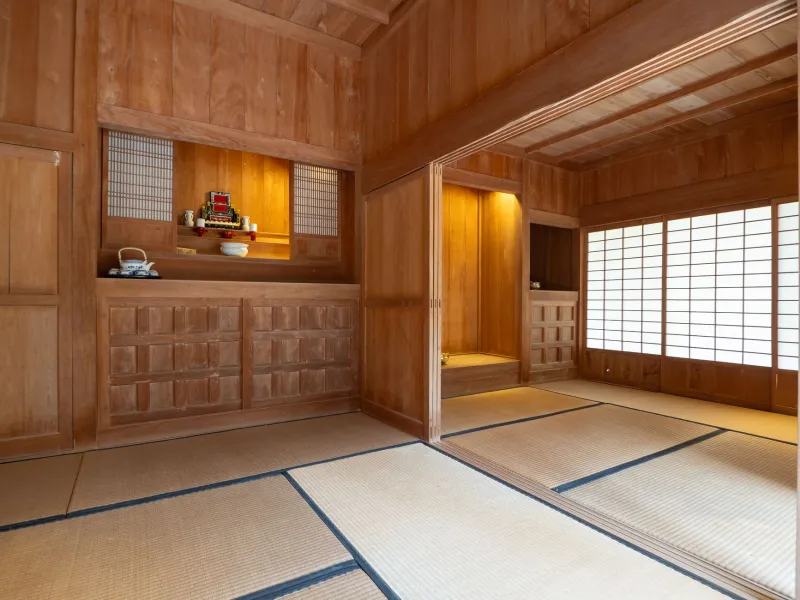
The materials chosen for tea house construction compound this effect. Earthen plaster walls, woven reed ceilings, and thick tatami flooring are each highly porous. Unlike the glass, concrete, and polished hardwood that dominate modern American interiors, these surfaces absorb rather than reflect sound waves, preventing the buildup of echo that makes conversation effortful. The layered paper of shoji screens adds a further dimension of acoustic softness, diffusing rather than bouncing the frequencies of human speech.
Architectural historian and Japan-based researcher Yoko Tanigawa has described the tea house as "a tuned instrument for human presence," noting that the proportional relationships between ceiling height, floor area, and wall material were not derived from abstract calculation but from generations of embodied experimentation — builders and tea masters adjusting, rebuilding, and listening until the room felt right.
Intimacy as Intention
Beyond material composition, the spatial logic of the tea house encodes a philosophy of encounter. The nijiriguchi — the small crawl-through entrance that requires every guest to bow upon entry, regardless of social rank — is widely discussed as a symbol of egalitarianism. Less often noted is its acoustic consequence: by slowing the entry of guests and sealing the room against the sounds of the outside world, it functions as a kind of transitional airlock, both psychological and physical.
The low ceiling height, typically around six feet in a classic tea room, creates what acousticians call an intimate acoustic field. Sound energy dissipates quickly in vertical space, meaning that voices do not need to compete for attention. A person speaking at conversational volume is heard clearly without projection, and the effort required to listen diminishes accordingly. The room, in effect, does part of the listener's work.
This is precisely the dynamic that American architects like David Hecht of the Portland-based firm Groundwork Studio are attempting to replicate in contemporary contexts. "We've spent decades designing for visual drama," Hecht has observed in professional forums, "and we've essentially forgotten that the ear is the organ of intimacy. The Japanese tea house tradition understood this at a level that most modern architectural education hasn't caught up to."
American Applications: From Boardrooms to Living Rooms
The translation of chashitsu principles into American design contexts is neither literal nor simple. Few American clients are prepared to install earthen plaster walls or tatami floors in their homes or offices, and the cultural rituals that animate the tea house cannot be imported wholesale. What can be extracted, however, is a set of transferable acoustic strategies.
Several American interior designers working in the hospitality sector have begun specifying cork and natural fiber wall panels — materials with absorption coefficients comparable to traditional Japanese plaster — in restaurant dining rooms and hotel lobbies. The goal is not to evoke Japan visually but to recover the acoustic conditions that make conversation feel worth having. In cities like Chicago, Seattle, and New York, a small but growing number of restaurants have begun advertising their acoustic environment as a selling point, a development that would have seemed eccentric a decade ago.
In residential design, the principles translate more organically. Architects drawing on Japanese spatial philosophy have experimented with lowered ceiling sections in dining areas, the strategic placement of textile wall hangings to break up reflective surfaces, and the use of natural wood and woven materials to introduce acoustic warmth. The results are spaces that feel, to their inhabitants, simply more comfortable — though the mechanism behind that comfort is rarely visible.
Corporate wellness consultants have also taken notice. Several large American employers, responding to research linking open-plan office acoustics with diminished cognitive performance and increased stress, have commissioned meeting room redesigns that incorporate Japanese-influenced proportions and material palettes. The emphasis, in each case, is on creating conditions for focused, unhurried exchange — the very conditions that the tea house was designed to sustain.
Silence as a Design Value
What the Japanese tea house ultimately teaches is that silence is not the absence of design but its highest aspiration. The chashitsu does not merely muffle noise; it constructs a particular quality of attention. Every material choice, every proportional decision, every threshold and surface contributes to an environment in which participants are gently compelled to be present with one another.
For American designers grappling with a built environment that often seems engineered for stimulation rather than connection, this represents a genuinely radical proposition. The dominant logic of contemporary American interior design rewards the visually arresting, the technologically sophisticated, and the spatially generous. The tea house tradition asks a different question entirely: What does this room ask of the people inside it?
The answer, in the best examples of chashitsu architecture, is that it asks them to listen — to the kettle, to the rain on the roof, and above all to one another. That this question is now being posed in architecture schools, design studios, and corporate offices across the United States suggests that the acoustic wisdom embedded in these small, unassuming structures has lost none of its relevance. If anything, it has never been more needed.
The rooms we build shape the conversations we are capable of having. Japan's tea masters understood this centuries ago. American design, slowly and with growing conviction, is beginning to agree.