The Art of Leaving Room: How Japanese Creators Treat Incompleteness as a Form of Mastery
In most Western creative contexts, a finished work carries a particular authority. The final brushstroke has been applied. The last seam has been sewn. The sculpture has been signed. Completion, in this framework, is the destination — the moment at which the artist steps back and the object steps forward into the world as something whole and resolved.
Yet within many of Japan's oldest artistic traditions, that moment of apparent resolution is regarded with a degree of suspicion. For certain masters of ceramics, printmaking, lacquerwork, and calligraphy, a work that appears too finished — too symmetrical, too sealed, too self-satisfied — is a work that has, in a meaningful sense, failed. The deliberate preservation of incompleteness is not an oversight or an affectation. It is a discipline as rigorous as any other, and one that carries centuries of philosophical weight.
The Philosophical Roots of the Unresolved
The concept most frequently cited in this context is ma — a Japanese term that resists easy translation but is often rendered as "negative space," "pause," or "interval." Ma is not emptiness in the sense of absence; it is emptiness understood as potential. In music, it is the silence between notes that gives each note meaning. In architecture, it is the threshold between rooms that makes both rooms habitable. In visual art, it is the unmarked portion of a composition that invites the viewer's eye — and imagination — to participate.
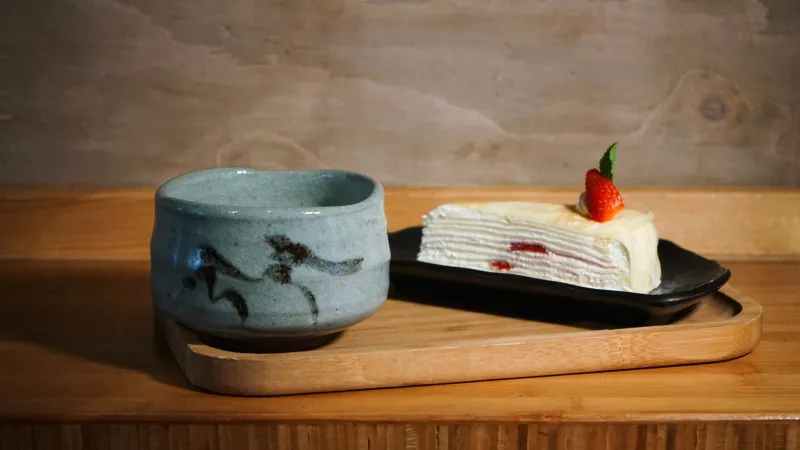
Equally foundational is the aesthetic principle of wabi-sabi, the embrace of impermanence and imperfection as qualities that carry their own beauty. Where Western aesthetics has historically prized symmetry, permanence, and finish, wabi-sabi finds its deepest resonance in the asymmetrical, the weathered, and the incomplete. A tea bowl with an uneven lip is not a lesser bowl; it is a bowl that acknowledges the limits of the human hand and, in doing so, becomes more human.
There is also the influence of Zen thought, which has long held that clinging to conclusions — in art as in life — is a form of attachment that obscures rather than reveals. An artwork that leaves something unresolved does not withhold; it opens.
What Deliberate Incompleteness Looks Like in Practice
The manifestations of this philosophy vary widely across disciplines. In the tradition of sumi-e ink painting, a master may complete a composition of bamboo stalks and leave a significant portion of the paper entirely untouched — not because the painting is unfinished, but because the unmarked space is doing as much work as the ink. The viewer's perception fills the void, making the act of looking an act of co-creation.
In woodblock printmaking, certain artists have maintained the practice of leaving margins unsigned or allowing the grain of the wood to interrupt the printed image in ways that a more controlling hand would have corrected. These interruptions are not errors. They are the print's way of acknowledging its own material nature — the fact that it emerged from a living tree, not from a machine.
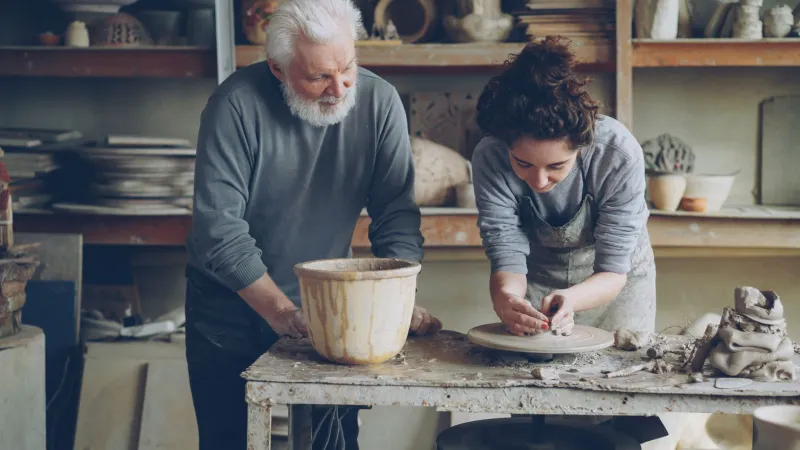
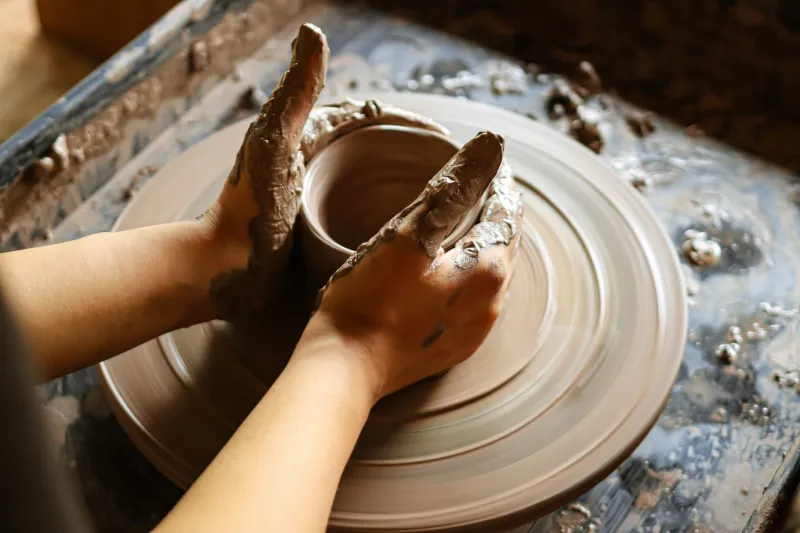
In ceramics, particularly within the tradition of raku ware associated with the tea ceremony, potters have long valued forms that resist perfect roundness. The pinch marks of the maker's fingers may remain visible. The glaze may pool unevenly. These qualities are understood not as signs of insufficient skill but as evidence that the object was made by a specific human being at a specific moment in time — a record of presence rather than an erasure of it.
American Artists Encountering the Practice
For many American artists trained within traditions that prize technical resolution, encountering this philosophy can be genuinely disorienting — and, ultimately, liberating.
Miranda Okafor, a ceramicist based in Portland, Oregon, spent two years studying under a Japanese-American master who had trained in Kyoto before returning to the Pacific Northwest. She describes her early encounters with the concept of deliberate incompleteness as "a kind of productive vertigo."
"Everything in my MFA training had oriented me toward the finished object," she explains. "You work toward a conclusion. You refine until the work holds together on its own. And then I was being asked to stop before that point — or to stop at a point that looked, to my eyes, like stopping too early. It took a long time to understand that what I was seeing as incompleteness was actually a different kind of completeness."
Okafor now incorporates what she describes as "intentional thresholds" into her work — moments within a piece where the hand has visibly paused, where the clay has been allowed to crack slightly along a seam rather than being smoothed away. "Those are the places where the viewer enters," she says. "If I seal everything, there's nowhere for them to go."
In Brooklyn, printmaker David Seo has explored similar territory through his engagement with Japanese woodblock traditions. Trained initially as a graphic designer, Seo was accustomed to the precision demanded by digital tools. His introduction to woodblock printing, and to the philosophy that an imperfect impression could be more truthful than a perfect one, required him to substantially reframe his understanding of what he was trying to accomplish.
"Design asks you to solve a problem completely," he reflects. "Printmaking, in this tradition, asks you to hold the problem open. The wood grain that bleeds through the ink — that's not a mistake I failed to correct. That's the wood speaking. If I silence it entirely, I've made something that could have been made by anyone, anywhere, at any time. The imperfection is what makes it specific."
The Challenge to Western Notions of Mastery
What makes this practice genuinely challenging to Western sensibilities is not merely aesthetic. It strikes at something foundational in how many Americans understand achievement itself. In a culture that tends to equate mastery with control — and completion with success — the idea that a master might deliberately leave work unresolved can read as either false modesty or conceptual obscurity.
But practitioners who have engaged seriously with these traditions argue that the opposite is true. Deliberate incompleteness requires more discipline, not less, because it demands that the artist resist the impulse to over-resolve — to keep working past the point at which the work is most alive. Knowing when to stop, and having the confidence to stop there, is itself a form of expertise that takes years to develop.
There is also a relational dimension to this practice that resonates with many American artists who have felt alienated by the transactional nature of the contemporary art market. A work that invites the viewer to complete it — imaginatively, perceptually, emotionally — is a work that treats the viewer as a participant rather than a consumer. The object becomes the beginning of a conversation rather than its conclusion.
Leaving Room for What Comes Next
The Japanese tradition of intentional incompleteness is not, at its core, about objects at all. It is about time — about acknowledging that all things exist within processes of change, and that any attempt to arrest that change through the fiction of a "finished" work is ultimately a kind of denial.
For American artists willing to sit with that discomfort, the rewards are considerable. The studio becomes less a place of resolution and more a place of inquiry. The work accumulates meaning not by becoming more complete but by becoming more honest about what it cannot contain.
In that openness — that deliberate, disciplined leaving of room — something essential is preserved: the sense that the conversation between maker, material, and viewer is never truly over.