Built to Outlast: How Japanese Joinery Is Reshaping the American Woodworker's Philosophy
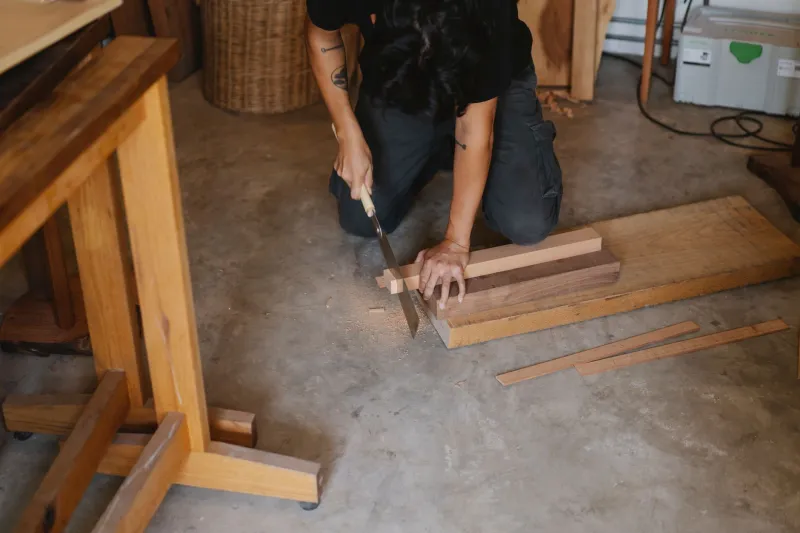
In a workshop tucked into the hill country outside Asheville, North Carolina, a furniture maker named Daniel Hurst spends weeks on a single joint. He is not troubled by this. The mortise and tenon connection he is cutting—a variation of the kigumi joinery tradition practiced in Japan for more than a thousand years—demands that kind of attention. Any shortcut, he will tell you, shows itself eventually. And eventually, in his vocabulary, means decades from now.
Hurst is among a growing number of American woodworkers who have turned to traditional Japanese joinery not as a stylistic affectation but as a foundational discipline. What draws them is not merely the aesthetic elegance of interlocking wood forms, though that elegance is considerable. What draws them is the underlying premise: that a structure built through precision, patience, and deep material knowledge need not rely on fasteners, adhesives, or anything beyond wood itself.
A Vocabulary Carved in Wood
Japanese joinery—known broadly as tsugite and shiguchi depending on whether the connections run lengthwise or at angles—encompasses hundreds of distinct joint types, each developed in response to specific structural demands. The dovetail, the butterfly key, the lapped mortise, the wedged through-tenon: these are not decorative flourishes. They are engineering solutions refined over centuries by master carpenters who built temples, shrines, and residences intended to endure not just lifetimes but epochs.
Some of the most celebrated examples remain standing in Nara and Kyoto, wooden structures that have survived earthquakes, fires, and the passage of more than a millennium. Their resilience is not incidental. It is the direct consequence of joinery systems designed to flex under stress, to distribute load intelligently across interlocking members, and to be disassembled and repaired without destroying the whole.
For American woodworkers raised in a tradition that often privileges speed and standardization, encountering this vocabulary for the first time can be genuinely disorienting. "I had been building furniture professionally for twelve years," says Hurst, "and the first time I saw a koshikake kama tsugi joint fully rendered, I realized I had been thinking about wood in entirely the wrong way."
The Tools of Deliberate Slowness
Mastering Japanese joinery requires not only new techniques but new tools and, more significantly, a new relationship with time. The nomi (chisel), kanna (hand plane), and nokogiri (saw) used in traditional Japanese woodworking are instruments calibrated for precision at a scale that power tools struggle to replicate. Many American practitioners seek out Japanese-made versions of these tools or work with domestic toolmakers who have studied their construction.
Workshops and immersive programs dedicated to these methods have emerged in cities including Portland, Seattle, and Brooklyn, as well as in rural communities where the slower pace of life seems to harmonize with the demands of the craft. Organizations such as the Timber Framers Guild have incorporated Japanese joinery study into their curricula, and individual master carpenters from Japan have conducted residencies and demonstrations at institutions across the country.
The learning curve is steep and deliberately so. A joint that looks simple on paper may require months of practice before it fits with the tolerances that the tradition demands—tolerances measured not in fractions of an inch but in the feel of resistance beneath a craftsperson's hands.
Against Disposability
The philosophical dimension of this resurgence cannot be separated from its technical one. American manufacturing culture has long operated under assumptions of replaceability: that objects are produced to be consumed, that wear is expected, that replacement is easier than repair. The furniture most Americans live with reflects these assumptions. Flat-pack construction, particleboard cores, and cam-lock fasteners produce objects that function adequately for a few years and then fail in ways that cannot be reversed.
Japanese joinery proposes a different contract between maker and object. A well-cut joint in white oak or cherry or walnut will, under ordinary conditions, outlast the person who made it. This is not hyperbole. It is a documented reality visible in the surviving wooden architecture of Japan and increasingly confirmed by the American craftspeople who are building with these methods today.
"There is something almost confrontational about it," says ceramicist and woodworking educator Mara Ellison, who teaches joinery workshops in the Hudson Valley. "When you hand someone a piece built this way, you are essentially telling them: this is not going anywhere. You are responsible for it now." That shift in responsibility—from manufacturer to owner, from disposability to stewardship—is one that resonates with a growing segment of the American public rethinking its relationship to material goods.
Structural Honesty as Aesthetic
Beyond philosophy, there is the matter of beauty. Japanese joinery is visually striking in a way that is inseparable from its structural logic. The exposed wedge of a through-tenon, the geometric interlock of a box joint corner, the subtle shadow line where two fitted members meet—these details announce themselves as honest expressions of how a thing is made. There is no veneer concealing the method. The method is the surface.
This aesthetic of structural transparency has found particular resonance among American architects and interior designers working in the tradition of craft-conscious modernism. Residential projects in California, the Pacific Northwest, and New England are increasingly incorporating exposed joinery as a primary design element—not as a historical reference but as a contemporary statement about values.
Furniture makers such as Portland-based Eliot Crane and the Brooklyn collective Timber & Form have built significant reputations around joinery-forward work, attracting clients who understand that what they are purchasing is not simply an object but a commitment to a different way of measuring worth.
Learning from the Long View
What Japanese joinery ultimately offers American woodworkers—and, through them, the broader culture—is a recalibration of scale. The relevant unit of time is not the product cycle or the warranty period but the generation. The relevant question is not how quickly something can be produced but how honestly it can be made.
This is, at its core, the lesson embedded in every kigumi joint: that the care taken at the moment of making determines the life of the thing made. It is a lesson as applicable to a dining table as to a timber-frame barn, as relevant to a first-year apprentice as to a master carpenter with decades of practice behind them.
In workshops across America, hands are learning to read wood grain with new attention, chisels are being sharpened to edges that would have satisfied craftspeople in Edo-period Japan, and the geometry of patience is being redrawn, one precise cut at a time.