Thread and Testimony: The American Designers Reweaving Japanese Textile Traditions into Acts of Meaning
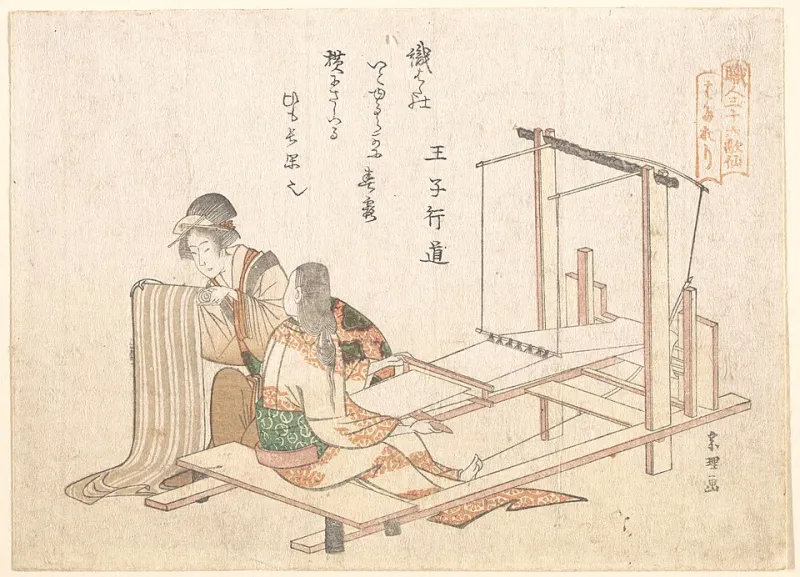
Photo: Katsushika Hokusai, CC0, via Wikimedia Commons
In the back room of a small Los Angeles studio, designer Keiko Murakami spreads a length of hand-woven fabric across a worktable. The cloth bears a pattern derived from seigaiha—the ancient overlapping wave motif that appears in Japanese decorative arts as far back as the Heian period. But the scale has been enlarged, the palette shifted from traditional indigo and white into deep ochre and ash gray, and the weave structure interrupted at deliberate intervals to create what Murakami describes as "a kind of visual stutter."
"The interruption is intentional," she explains. "It represents the experience of being Japanese-American—the tradition is there, it's real, it's yours, but it doesn't come to you unbroken."
Murakami's work sits at the center of a conversation that is growing louder across American fashion, textile arts, and cultural criticism: What does it mean to work with Japanese textile traditions in the United States today? Who holds the authority to do so? And what responsibilities accompany the act of translating a craft tradition—one shaped over centuries by specific cultural, ecological, and social conditions—into a new context?
A Living Archive
To appreciate what is at stake in this conversation, it helps to understand what Japanese textile traditions actually represent. Japan's history of cloth production is among the most technically sophisticated and symbolically rich in the world. Techniques such as kasuri (ikat weaving, in which threads are resist-dyed before weaving to create blurred, pixelated patterns), shibori (a family of shaped-resist dyeing methods), nishiki (brocade weaving of extraordinary complexity), and bingata (the stencil-dyeing tradition of Okinawa) are not merely decorative practices. They are archives.
Each pattern carries historical information: regional identity, seasonal reference, social status, spiritual protection. The asanoha (hemp leaf) pattern, for example, was traditionally used for infant garments because the fast-growing hemp plant was believed to confer vitality. The sayagata (linked swastika, a Buddhist symbol of eternity) appears on formal garments as a marker of auspicious occasion. These are not ornamental choices. They are a form of writing.
Dr. Patricia Huang, a textile scholar at the Rhode Island School of Design who specializes in cross-cultural pattern migration, describes Japanese textile motifs as "one of the most coherent symbolic systems in the history of decorative art. When you use them, you are entering a conversation that has been going on for over a thousand years. The question is whether you know that—and whether you care."
The Designers in the Conversation
Among the American designers engaging most seriously with Japanese textile traditions, a spectrum of approaches is visible. At one end are practitioners like Murakami, who work from a position of inherited connection—Japanese-American designers for whom engagement with these traditions is, in part, an act of cultural recovery. At the other end are non-Japanese designers who have studied these techniques formally, often training in Japan or under Japanese master weavers in the United States, and who approach the traditions with scholarly rigor and explicit acknowledgment of their sources.
Between these poles lies considerable variation, and not a little controversy.
Tomás Rivera, a Brooklyn-based menswear designer of Mexican heritage, spent two years studying kasuri weaving under a Japanese-American master weaver in Northern California before incorporating the technique into his collections. His work draws explicit parallels between Japanese kasuri and the Mexican rebozo weaving tradition—both involve pre-dyed threads, both encode cultural identity, and both have been subject to commercial appropriation. "I'm not claiming Japanese heritage," Rivera says carefully. "I'm claiming a conversation between traditions that have more in common than most people realize. But I work hard to make that conversation visible, not to erase it."
Rivera's approach—documentation, attribution, and cross-cultural dialogue rather than simple borrowing—is increasingly cited by fashion scholars as a model for ethical engagement with heritage craft.
Where Celebration Becomes Controversy
Not all such engagements are received equally. The American fashion industry's history with Japanese aesthetics includes episodes that the Japanese artisan community has found troubling: mass-market garments bearing kamon (family crests) stripped of their heraldic meaning, fast-fashion prints loosely derived from kimono textiles with no acknowledgment of their origins, and wellness brands marketing boro-inspired patchwork as a "minimalist aesthetic" without reference to the fact that boro cloth was historically the fabric of rural poverty—garments mended and remended out of necessity by families who could afford nothing new.
For Hiroshi Tanaka, a fifth-generation textile artisan in Kyoto whose family has produced nishijin-ori brocade for over a century, the issue is not simply one of cultural sensitivity. It is economic. "When a pattern my family has woven for generations appears on a mass-produced garment sold for twenty dollars in an American chain store, it does not honor the tradition. It competes with it. And it competes unfairly, because the garment carries none of the cost—in time, in skill, in materials—that the real thing requires."
Tanaka's concern points to a dimension of the appropriation debate that is sometimes overlooked in cultural discussions: the material impact on living artisans whose livelihoods depend on the perceived value of their craft.
Pattern as Political Language
Yet the picture is not solely one of loss and contestation. For many Japanese-American designers and artists, the reclamation of Japanese textile traditions has become an explicitly political act—a means of asserting cultural presence in a country where that presence has historically been subject to erasure.
The incarceration of Japanese Americans during World War II severed many families from their craft traditions, their material culture, and their sense of continuity. For designers like Murakami and others working in her generation, engaging with Japanese textile heritage is inseparable from this history. "My grandmother lost almost everything when her family was sent to the camps," Murakami says. "She kept one furoshiki—a wrapping cloth. I think about that cloth every time I work."
This dimension of the movement—textile tradition as a form of historical witness—has drawn the attention of curators, scholars, and activists alike. Several recent exhibitions at American museums have explicitly framed Japanese-American textile work in the context of redress and resilience, situating craft not as decorative practice but as political testimony.
The Artisan's Perspective
For Japanese master weavers and dyers who have chosen to teach their techniques to American students—a choice itself not without complexity—the question of legacy is paramount. Many express a nuanced position: they are not opposed to the transmission of their craft across cultural boundaries, but they insist that transmission must be accompanied by genuine understanding.
"A pattern is not just a design," says weaver Emiko Sasaki, who has taught shibori workshops in San Francisco for fifteen years. "It is a way of seeing. If you learn only the shape and not the seeing, you have learned very little. I want my students to understand why the pattern exists before they decide what to do with it."
That distinction—between learning a technique and understanding the worldview it embodies—may be the most important thread running through this entire conversation. Japanese textile traditions survived centuries not because they were static, but because each generation that inherited them understood what was at stake in their preservation. The American designers who engage with these traditions most meaningfully appear to share that understanding: that cloth, at its most profound, is never merely cloth. It is a record of what people believed, what they endured, and what they chose to carry forward.