The Gift of Getting It Wrong: How Japanese Masters Use Failure as the Foundation of True Craft
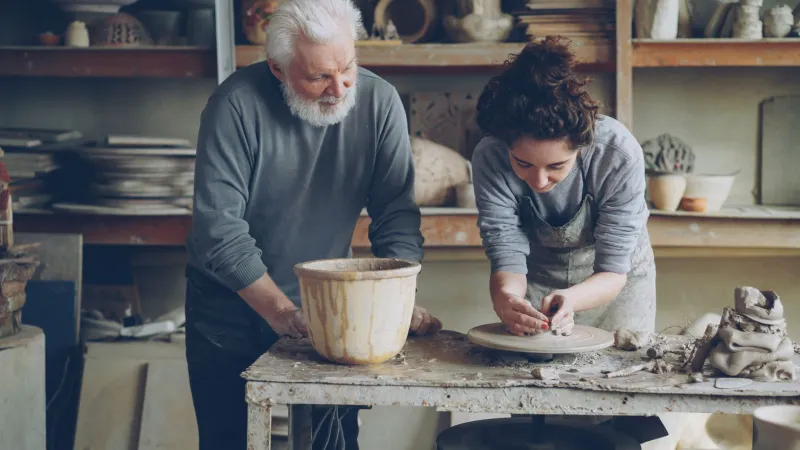
There is a moment, familiar to nearly every American who has apprenticed under a Japanese craft master, when the instruction stops. The teacher steps back. The student, uncertain and unguarded, proceeds—and makes exactly the error the master anticipated. What follows is not correction. It is silence, observation, and, eventually, a question: What did you notice?
This pedagogical stillness confounds many Western learners accustomed to systems designed to minimize error. In American vocational and art education, mistakes are typically intercepted before they fully materialize. Progress is measured in successful outputs. Mastery is demonstrated through accumulating correct results. But in the traditional ateliers and studios where Japanese craft lineages are preserved, the philosophy runs in a profoundly different direction—one in which the mistake is not the interruption of learning but its very engine.
Structured Imperfection
The concept is not accidental permissiveness. Teachers within traditional Japanese craft systems distinguish carefully between the errors a student must be allowed to make and those that would cause irreversible harm to materials or tools. Within that boundary, however, the range of permitted—and sometimes deliberately induced—failure is striking.
Takahiro Yamamura, a lacquerware master based in Wajima whose family has practiced urushi for four generations, describes the approach with characteristic economy: "If I correct every stroke, the student learns my hand. They do not learn their own." For Yamamura, the goal of apprenticeship is not replication but internalization—and internalization, he argues, cannot occur without personal encounter with consequence.
This philosophy has deep structural roots. Traditional Japanese apprenticeship, particularly in craft disciplines, has long operated on a model in which the early years involve repetitive, foundational tasks performed without full explanation. The student is not told why a particular motion matters; they are expected to discover it through sustained, embodied practice. Failure, in this context, functions as a form of feedback that no verbal instruction can replicate.
What American Apprentices Encounter
For Americans who enter these training environments, the adjustment is rarely comfortable. Rachel Morrow, a ceramicist from Portland, Oregon, spent eighteen months in Kyoto studying under a yakimono master after a decade of building her own studio practice. She describes her initial months as a sustained experience of productive disorientation.
"I kept waiting for him to tell me what I was doing wrong," she recalls. "He would watch me throw a bowl that was clearly off-center, and he wouldn't say anything. I'd finish it, and he'd look at it, and then he'd ask me how it felt in my hands while I was working. Not how it looked—how it felt. That question completely changed how I understood what I was supposed to be paying attention to."
Morrow's experience reflects a pattern reported by numerous American apprentices in traditional Japanese settings. The master's withholding of correction is not indifference; it is a deliberate redirection of the student's attention from external validation toward internal perception. The question How did it feel? insists that the learner develop their own evaluative sensibility rather than relying on the teacher's judgment as a substitute for their own.
This stands in marked contrast to the feedback cultures many American artisans encounter in their domestic training. Critique in Western art education tends to be verbal, immediate, and externally delivered. The instructor identifies the flaw and names it. The student receives the assessment and adjusts. The process is efficient and, in many respects, effective—but it produces a learner whose calibration depends on the presence of the teacher. Remove the instructor, and the student may find themselves without the internal compass to navigate uncertainty.
Failure as Vocabulary
Japanese craft pedagogy treats error as something closer to vocabulary than to deficiency. Each mistake a student makes becomes part of a growing lexicon of embodied knowledge—an understanding of how materials behave, how the body responds under fatigue or tension, how attention wavers and what that wavering costs.
Koji Nishimura, who teaches traditional katazome textile dyeing and has worked with several American students over the past decade, describes this accumulation as essential to what he calls "craft memory." "When a student has never failed," he explains, "they have no memory of recovery. When difficulty comes—and it always comes—they do not know how to find their way back. The student who has struggled and found the path again knows the territory. The one who was always guided does not."
Nishimura's framing suggests that the value of failure in Japanese craft training is not simply psychological resilience, though that is part of it. It is cartographic. The student who has navigated error has mapped the terrain of their discipline in a way that the error-free student has not. They know where the ground is unstable because they have felt it give way.
Rethinking Achievement
For American apprentices returning from Japan, the reintegration into domestic craft culture can be its own form of dissonance. The emphasis on demonstrable, measurable achievement that characterizes much of American professional and artistic life sits uneasily alongside a training philosophy that prizes struggle, patience, and the willingness to sit with imperfect work.
Morrow describes teaching her own students now with a different set of instincts than she arrived in Kyoto with. "I catch myself wanting to fix things before they go wrong," she says. "And then I remember being asked how something felt. I try to ask that question first. It changes the conversation entirely."
The tension she describes is not easily resolved, and it would be reductive to suggest that Japanese craft pedagogy is without limitation or that Western training methods offer nothing of value. What the comparison illuminates, rather, is a fundamental difference in the assumptions underlying each approach—about what knowledge is, how it is transmitted, and what a finished artisan is ultimately supposed to possess.
The Patience Required
What Japanese masters consistently emphasize, and what American apprentices consistently report learning slowly, is that the pedagogy of deliberate failure requires an unusual quality of patience—not passive waiting, but active, attentive endurance. The student must remain present with discomfort rather than seeking its immediate resolution. The master must resist the impulse to rescue.
That restraint, Yamamura suggests, is itself a form of respect. "To correct every mistake is to say: I do not trust you to find your way. To allow the struggle is to say: I know you can." In the world of Japanese craft tradition, where the relationship between master and apprentice carries the weight of lineage and inheritance, that trust is not a small thing. It is, in many ways, the most significant gift the teacher has to offer.
For the growing community of American artisans seeking immersion in these traditions—whether through travel, residency programs, or the expanding network of Japanese-trained teachers working in the United States—this pedagogical philosophy represents more than a technique. It represents an invitation to reconsider what learning is for, and what it means to be truly prepared for the long work of craft.