Breath Before Sound: How American Jazz Musicians Are Finding New Improvisational Freedom in the Ancient Discipline of Shakuhachi
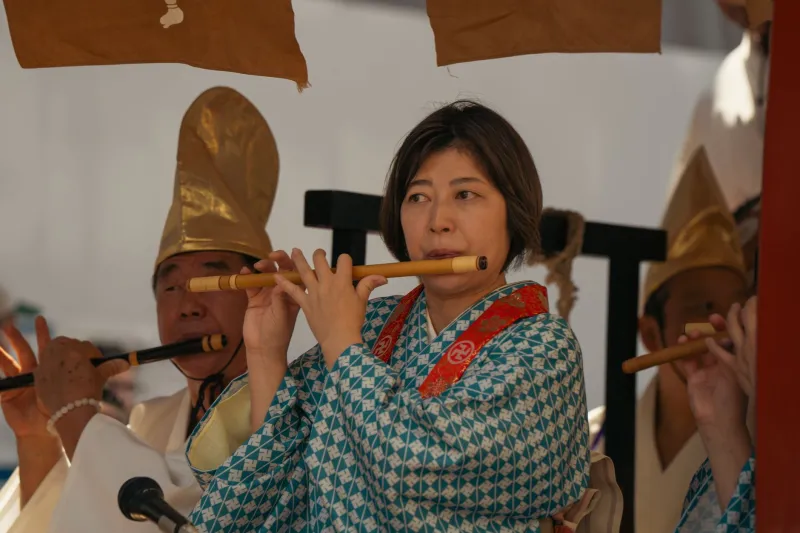
There is a moment in shakuhachi performance that has no direct equivalent in Western musical training. Before the first note is drawn from the bamboo flute, the player holds stillness — not as preparation, but as intention. The silence is not empty. It is, in the vocabulary of traditional Japanese music, the beginning of the phrase itself.
For a growing cohort of American jazz musicians, that moment has become a revelation.
A Tradition Rooted in Breath and Buddhist Practice
The shakuhachi — a vertical bamboo flute with origins traceable to Tang Dynasty China but refined into a distinctly Japanese art form by the 13th century — was historically played by wandering Zen Buddhist monks known as komusō. For these practitioners, the instrument was not primarily a vehicle for musical entertainment. It was a tool of meditation, a means of cultivating presence through the act of sustained, controlled breath.
The flute's construction demands an unusual intimacy between player and instrument. Unlike Western woodwinds, the shakuhachi has no reed and no mouthpiece in the conventional sense. The player blows across a beveled edge at the top of the tube, and the resulting tone is profoundly sensitive to the angle and pressure of the breath. A slight shift in embouchure can transform a clear pitch into a breathy whisper, a moan, or a tone that seems to dissolve into the surrounding air. Mastery is measured not in technical speed, but in the quality and expressiveness of a single sustained note.
This is precisely what has captured the attention of jazz musicians wrestling with what many in the community describe as a crisis of excess.
When More Becomes Less
American jazz has always prized virtuosity. From bebop's cascading runs to the harmonic density of post-bop improvisation, the tradition rewards musicians who can navigate complex chord changes with speed and precision. Yet a number of prominent voices within the contemporary jazz scene have begun to question whether that emphasis on technical abundance has come at a cost to emotional clarity.
Saxophonist and composer Marcus Ellery, who began studying shakuhachi with a teacher in Los Angeles after a decade of professional performance, describes the experience as disorienting in the most productive sense. "I had spent years learning how to fill space," he has said in interviews. "Shakuhachi taught me that filling space is often just a way of avoiding what the space is asking you to say."
This observation points directly to the Japanese concept of ma — a term that resists clean translation but is broadly understood as the meaningful pause, the interval, the productive gap between sounds or events. In Japanese aesthetics, ma is not absence. It is presence of a different kind: the silence that gives surrounding sound its weight and definition.
For jazz improvisers trained to regard silence as a risk — a moment when momentum might falter or audience attention might wander — the discipline of ma represents a fundamental reorientation. It asks the musician to trust that a well-placed rest communicates more than a flurry of notes ever could.
Cross-Cultural Study as Artistic Discipline
Several American music conservatories and community arts programs have begun incorporating shakuhachi instruction into jazz curricula, not as a novelty elective but as a serious component of improvisational training. At institutions in New York, Chicago, and the Bay Area, students are being introduced to honkyoku — the solo repertoire of the komusō tradition — as a means of developing what instructors describe as "melodic economy" and "intentional silence."
The parallels between shakuhachi philosophy and the work of certain canonical jazz figures are frequently invoked in these contexts. Miles Davis's late 1950s recordings, particularly the landmark Kind of Blue, are cited for their spaciousness — the deliberate restraint with which Davis deployed notes, leaving room for texture and atmosphere to carry meaning. Pianist Ahmad Jamal's use of silence as punctuation has long been admired within the jazz world. What shakuhachi study offers, proponents argue, is a structured, philosophically grounded framework for developing these instincts rather than simply admiring them in others.
Flutist Diane Yoshida, a Japanese-American artist who has performed in both traditional shakuhachi contexts and contemporary jazz ensembles, describes the two traditions as sharing "a common conversation about vulnerability." To play with restraint, she observes, is to expose oneself. There is nowhere to hide behind ornamentation. Every note bears the full weight of the performer's intention.
The Sound of a Single Tone
One of the most demanding exercises in shakuhachi practice is deceptively simple: sustaining a single tone for as long as breath will allow, with complete consistency of pitch, tone color, and dynamic. The exercise has no jazz equivalent in formal pedagogy, yet musicians who have undertaken it describe a profound effect on their improvisational instincts.
"You start to hear differently," says pianist and educator Robert Tanaka, who spent two years studying shakuhachi before returning to his primary instrument. "You become aware of the interior life of a note — the way it begins, the way it sustains, the way it ends. And then you bring that awareness back to the piano, and suddenly every note you play has that same interior life. You're not just hitting keys. You're breathing through the instrument."
This quality of attention — what the shakuhachi tradition cultivates as ichion jōbutsu, or "attaining enlightenment through a single sound" — is increasingly recognized within American jazz circles as a counterweight to the culture of technical accumulation that can sometimes flatten the emotional range of even highly skilled performers.
A Living Exchange
What makes this cross-cultural dialogue particularly meaningful is that it is not a matter of appropriation or superficial borrowing. The American musicians engaging most seriously with shakuhachi are doing so through sustained study with qualified teachers, many of them Japanese or Japanese-American practitioners who carry direct lineages of transmission. The exchange is reciprocal: several shakuhachi masters have spoken of the ways in which their engagement with jazz musicians has deepened their own understanding of how the tradition's principles translate across cultural contexts.
In this sense, the shakuhachi's journey into American jazz reflects something larger — a recognition that the most profound traditions are not diminished by contact with other forms of expression. They are, instead, revealed more fully. The bamboo flute that once accompanied a monk's solitary walk through a mountain pass is now, in rehearsal rooms from Brooklyn to Oakland, teaching a new generation of improvisers that the most powerful musical statement is sometimes the one they choose not to make.
The breath before the sound, it turns out, was always part of the music.