The Unwritten Map: How Japanese Festival Crowds Navigate Space, Trust, and One Another
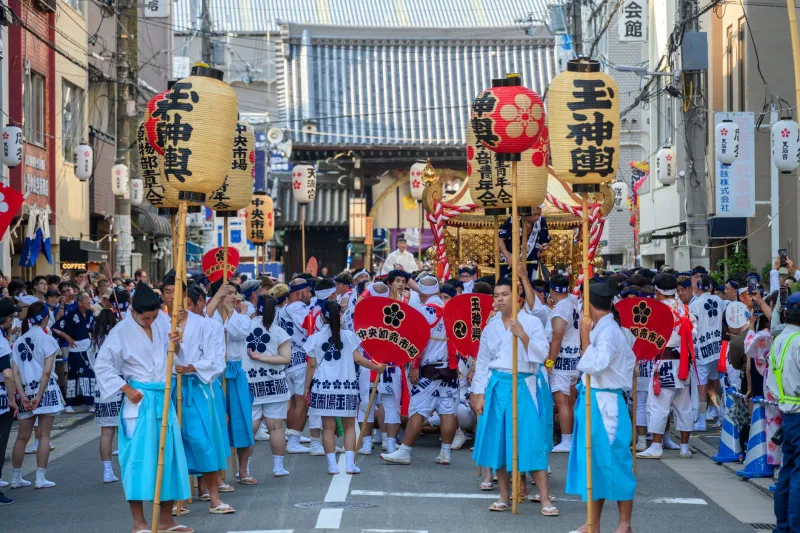
Consider what it means to stand in a crowd. In most American contexts—a concert, a street fair, a stadium concourse—the crowd is something to be managed, navigated, or endured. Personal space is defended. Eye contact with strangers is minimized. The collective is experienced primarily as an obstacle to individual movement and comfort.
Now consider a different kind of crowd. One in which strangers yield to one another with a kind of instinctive grace. In which the press of bodies feels less like an imposition and more like a shared condition that everyone has, without negotiation, agreed to inhabit together. In which the density of people does not produce anxiety but something closer to its opposite.
This is, for many Americans, their first encounter with a traditional Japanese festival crowd—and the contrast is striking enough to demand explanation.
Social Architecture Before the First Step
The anthropologist's term for what occurs in a Japanese festival setting is ma no kyōyū—the sharing of interval, or shared space-in-between. It describes a collective orientation toward the gaps between people and things as something to be respected and managed communally, rather than claimed by whoever moves fastest.
This orientation does not appear spontaneously on festival day. It is the product of cultural conditioning that begins in childhood and is reinforced across every domain of Japanese social life: the orderly boarding of trains, the precise etiquette of the school lunch line, the spatial awareness that governs even casual pedestrian movement on a busy Osaka street. By the time a Japanese participant enters a festival ground, the behavioral grammar of shared space is so thoroughly internalized as to be invisible.
For the American visitor, that grammar is anything but invisible. It is, in fact, one of the most immediately legible differences between Japanese and American crowd behavior—and one of the most disorienting, in the best possible sense.
"I kept waiting for someone to push," recalls a festival-goer from Minneapolis who attended the Gion Matsuri in Kyoto several years ago. "There were hundreds of thousands of people and nobody pushed. I didn't understand it as a cultural thing at first. I just thought: something is different here. Something is working that doesn't usually work."
The Permission Structure of the Festival
Beyond the mechanics of physical navigation, Japanese festivals operate according to what sociologists sometimes call a "permission structure"—a set of implicit social agreements that expand the range of behavior considered acceptable within a defined space and time.
In everyday Japanese social life, emotional restraint is a widely observed norm. Public displays of enthusiasm, vulnerability, or interpersonal warmth toward strangers carry a degree of social risk. The festival suspends many of these norms without abolishing the underlying social order. Under the lanterns, in the noise and color of the matsuri, strangers speak to one another. Children approach adults they do not know to admire their yukata. Elderly participants and young couples occupy the same bench without awkwardness.
This is not accidental. It is the designed function of the festival as a social institution. The matsuri has historically served as a pressure-release valve for communities governed by strict everyday codes of conduct—a sanctioned occasion for warmth, play, and connection that the ordinary social calendar does not easily provide.
For Americans, who often experience the opposite problem—a cultural norm of surface friendliness that rarely produces genuine connection—the festival's permission structure can feel revelatory.
"I talked to more strangers in three hours at the Awa Odori than I had in the previous six months at home," says a software engineer from Seattle who attended the famous Tokushima dance festival during a work assignment in Japan. "And not small talk. Real conversations. People asking what I thought of the dancing, telling me about their grandparents who used to perform. I didn't know how to account for it."
Sensory Architecture and Emotional Availability
Part of what makes the Japanese festival crowd behave differently is the environment the festival itself creates. The sensory landscape of a traditional matsuri—the rhythmic pulse of taiko drums, the warm light of paper lanterns, the ritualized sequence of processions and performances—is not merely decorative. It is functionally transformative.
Research in environmental psychology has long established that sensory environments shape social behavior. Spaces characterized by rhythmic sound, warm lighting, and clearly defined communal focus tend to reduce individual defensiveness and increase social openness. The traditional Japanese festival, refined over centuries of communal practice, achieves these conditions with remarkable consistency.
The taiko drum, in particular, deserves attention. Its low-frequency resonance is felt as much as heard—a physical experience that, neurologically, promotes a sense of shared embodiment among those present. Participants in a taiko performance do not merely listen together; they vibrate together, in a quite literal sense. The social consequences of that shared physical experience are not trivial.
"There's a reason the drum has been central to collective ritual across so many cultures," notes one cultural anthropologist who has studied festival crowd dynamics in both Japan and the United States. "It bypasses the cognitive filters that keep strangers at a distance. You can't easily maintain social armor when something is resonating in your chest."
What American Gatherings Are Missing
The contrast between the social experience of a Japanese festival and that of a typical American public gathering reveals something important about the design choices—often unconsidered—that shape how communities come together.
American public events tend to be organized around consumption: a performance to watch, a product to purchase, a spectacle to witness. Participation is largely passive. The crowd is an audience, not a community. The social architecture directs attention outward, toward the stage or the vendor, rather than inward, toward one another.
Japanese festivals, by contrast, are organized around participation. Even the observer is implicated in the event—by the procession that moves through the crowd rather than past it, by the communal dance that invites anyone to join, by the food stalls that require navigating shared space together. The crowd is not the audience. The crowd is the festival.
This distinction has not been lost on the Americans who have begun to examine their own cultural gatherings through this lens. A number of community organizers in cities with active Japanese cultural networks have begun deliberately incorporating festival design principles—processional movement, communal food preparation, rhythmic sound—into events that have nothing to do with Japanese culture per se, but everything to do with the quality of human connection those events aspire to produce.
The Lesson the Crowd Teaches
What Japanese festival crowd dynamics ultimately reveal is that belonging is not a feeling that arises spontaneously among people who happen to occupy the same space. It is the product of deliberate design—of environments, rituals, and social agreements that create the conditions under which strangers can, briefly and genuinely, become something more.
In an era when Americans report historically high levels of loneliness despite unprecedented connectivity, that lesson carries weight far beyond the festival grounds. The matsuri is not a solution to social fragmentation. But it is a working demonstration that the problem is not intractable—that human beings, given the right architecture, will find one another.