Marking the Year: How American Families Are Using Japanese Seasonal Observances to Reclaim Time from the Digital Current
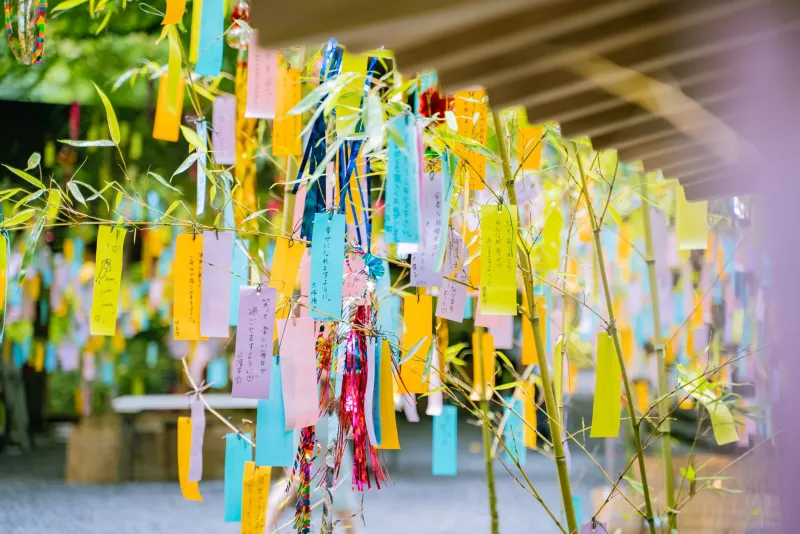
Somewhere in suburban Minneapolis, a family is writing wishes on strips of colored paper. It is the evening of July seventh, and the Okafor household — two parents, three children between the ages of six and fourteen — has gathered around a small bamboo branch set in a ceramic pot near the living room window. Each strip of paper bears a single wish, written with deliberate care. When the writing is done, the strips are tied to the bamboo, and the family sits together without screens for what has become, over four years of practice, one of the anchoring rituals of their shared life.
They are observing Tanabata — the Japanese Star Festival, rooted in an ancient Chinese legend about two celestial lovers permitted to meet only once each year, on this night alone. The Okafor family has no Japanese ancestry. They encountered the festival through a book of world seasonal traditions, recognized something in its structure that their household needed, and began practicing it the following July. They have not missed it since.
"The first year, it felt a little awkward," admits Adaeze Okafor, who works as a hospital administrator. "But the kids took to it immediately, and by the second year it felt like ours. Not Japanese, exactly. Ours. A thing our family does on this night."
The Hunger for Structured Time
The Okafors are not alone. Across the United States, a growing number of families — drawn from varied ethnic, professional, and geographic backgrounds — are deliberately incorporating Japanese seasonal observances into their annual calendars. The festivals they are adopting are not chosen at random. They share a set of characteristics that appear to address specific deficits in contemporary American domestic life: they are precisely dated, they require preparation, they are conducted largely offline, and they are oriented toward something larger than individual preference or productivity.
This is, in part, a response to a problem that has become almost universal among American households: the dissolution of temporal structure under the pressure of digital connectivity. When work arrives at all hours, when entertainment is available on demand, when no moment is categorically different from any other moment, the year loses its shape. Seasons blur. Occasions collapse into one another. The sense of time as something moving through a meaningful arc — toward something, away from something — attenuates.
Japanese seasonal culture offers a different model. The Japanese calendar has historically been organized around a dense web of observances, each tied to a specific moment in the natural and agricultural year, each carrying its own aesthetic register, its own foods, its own forms of preparation and reflection. To live within that calendar is to live in a year that has texture — that is not uniform, that surprises and demands and rewards attention.
Hatsumode and the Logic of the First
For several families interviewed for this piece, the entry point into Japanese seasonal practice was not summer but winter. Hatsumode — the first shrine visit of the new year, traditionally undertaken in the days immediately following January first — resonates with American families in part because the new year is already a culturally familiar threshold. What Hatsumode adds is structure and intention.
The Liebowitz family in Chicago began observing a secular version of Hatsumode three years ago, after the parents — both educators — became concerned that New Year's Day had become, for their household, simply a day of recovery from the previous night. "We wanted the day to mean something," says Daniel Liebowitz. "We wanted to go somewhere together, outside, in the cold, and do something that felt deliberate."
They began taking a family walk on the morning of January second — chosen over the first to avoid conflict with other commitments — to a local Japanese garden that remains open year-round. They bring small written intentions, read them aloud at the garden's stone lantern, and observe a period of silence before returning home for a shared meal. The practice has no religious content for their family, but it has something they describe, carefully, as gravity.
"The kids look forward to it. They prepare for it. My older daughter spent two weeks last December thinking about what she wanted to say at the lantern," Liebowitz says. "That kind of sustained, purposeful reflection — I'm not sure where else in their lives they're being invited to do that."
Omagatoki: The Practice of the In-Between
Perhaps the most unexpected seasonal practice to find American adherents is one that is not, strictly speaking, a festival at all. Omagatoki — the Japanese term for the liminal period at dusk when day and night are equally present and the boundary between the human and spirit worlds is understood to thin — has been adopted by several families as a daily or weekly practice of intentional pause.
The concept entered American wellness discourse through a combination of travel writing and social media, but the families who have integrated it most meaningfully describe discovering it through research rather than trend. For the Reyes family in Austin, Texas, Omagatoki began as an experiment during the early months of the pandemic, when the structure of daily life had collapsed entirely.
"We started going outside every evening around dusk — just to be outside, just to watch the light change," says Elena Reyes, a graphic designer. "Then I read about Omagatoki and I thought, 'That's what we've been doing.' Giving it a name, giving it a history, made it feel more serious. More worth protecting."
The Reyes family now treats dusk on Fridays as a household threshold — a moment when devices are set aside, outdoor shoes are put on, and the family walks together for as long as the light is changing. The practice takes, on average, twelve minutes. Its effect on the household's weekly rhythm, Elena says, is disproportionate to its length.
On Borrowing with Care
The families engaged in these practices are, by and large, thoughtful about the nature of what they are doing. Most have spent time learning the historical and cultural context of the observances they have adopted. Several have made deliberate efforts to ensure that their children understand the traditions' origins — that Tanabata is not simply a wish-making night but a specific story from a specific culture with a specific aesthetic history.
"We're not pretending to be Japanese," says Adaeze Okafor. "We're learning from a tradition that has figured something out about time and attention and community that we hadn't figured out on our own. That feels like respect, not appropriation — as long as we're honest about it."
What these families have found, in the end, is something that the architects of Japan's seasonal calendar understood long ago: that the human experience of time is not simply given. It is made. It is made by the moments we choose to mark, the preparations we choose to undertake, the pauses we choose to honor. In a year that can so easily become a featureless stream of notifications and obligations, a bamboo branch hung with colored paper, a walk taken at dusk, a silent moment beside a stone lantern in January — these are not small things. They are, for the families who practice them, the shape of the year itself.