The Craft Before the Screen: American Families Turning to Japanese Handwork as a New Language of Childhood
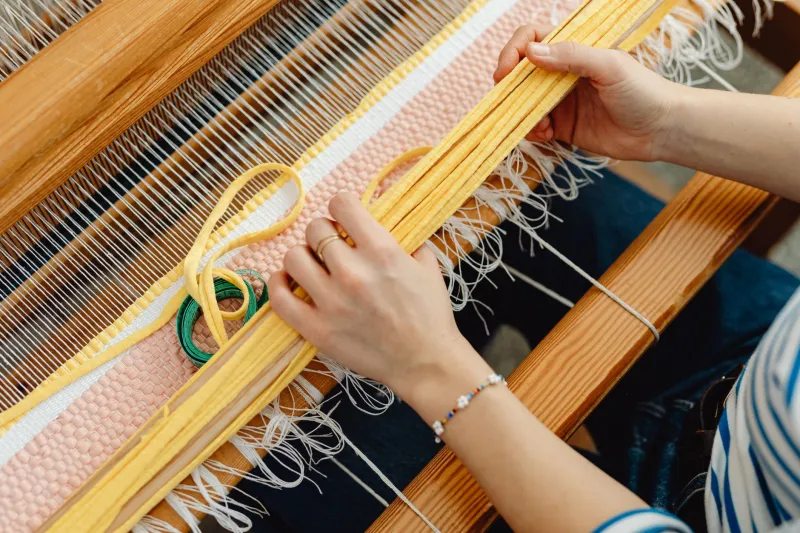
On a Saturday morning in suburban Minneapolis, a nine-year-old named Clara is not watching a video. She is seated at a low table, working a simple wooden loom her mother purchased from a Japanese craft supplier, threading undyed cotton through a warp she set herself, with guidance from a printed instruction sheet translated from a Japanese elementary school manual. She has been at it for forty minutes. She has not asked for her tablet once.
Her mother, a graphic designer, did not expect this. "I thought we'd do it for twenty minutes and she'd be done," she says. "But there's something about the repetition. She gets into a state I don't see when she's doing anything else."
This scene, in its particulars, is becoming less unusual across the United States.
A Movement Without a Manifesto
There is no single organization driving the integration of traditional Japanese crafts into American childhood education. What exists instead is a loose and growing network of families, small independent educators, Japanese-American community programs, and craft-focused homeschool co-operatives who have arrived at similar conclusions through different paths.
Some came through exposure to Japanese cultural programming—museum workshops, community center demonstrations, travel. Others encountered the philosophy of monozukuri—the Japanese concept of making things with care, craft, and a spirit of dedication—through reading or professional contact with Japanese design and manufacturing culture. A smaller number were introduced to these practices through formal Waldorf or Montessori educational frameworks, which share certain philosophical overlaps with Japanese approaches to handwork in childhood.
What unites them is a shared dissatisfaction with the texture of contemporary American childhood, and a belief that the hand—specifically, the engaged, purposeful, materially grounded hand—offers something that digital environments structurally cannot.
What Japanese Pedagogical Philosophy Understands
In Japan, handcraft has occupied a deliberate place in childhood education for generations. The integration of craft activities into primary schooling is not incidental; it reflects a philosophical position, articulated across various educational traditions, that the development of fine motor skill, material attention, and patient repetition in childhood creates neurological and character foundations that transfer broadly.
The concept of kata—the structured, repeated form that underlies mastery in Japanese craft, martial arts, and performing arts—appears in children's craft education as an organizing principle. A child learning to fold paper correctly, to cut along a line with a proper tool, or to weave a consistent pattern is not simply acquiring a skill. Within this framework, they are developing the capacity for disciplined attention that will inform everything they learn afterward.
This is not merely philosophical assertion. American developmental psychologists and occupational therapists have independently documented the cognitive and behavioral benefits of sustained fine motor engagement in early childhood. Research supports connections between handcraft activities and improvements in working memory, impulse regulation, spatial reasoning, and tolerance for frustration. The Japanese pedagogical framework and the Western developmental literature, arriving from different traditions, point in the same direction.
Families on the Ground
In Portland, Oregon, a Japanese-American father of three has structured his family's weekend mornings around rotating craft sessions drawn from traditional Japanese practice. The activities range from origami at the simpler end to basic kumihimo braid-making with a wooden disk loom, and, for his eldest child, introductory work with hand tools guided by principles from Japanese woodworking.
"What I noticed immediately was the quality of attention," he says. "With a screen, attention is managed for you—the content keeps changing to hold you. With a craft, you have to manage your own attention. That's a completely different cognitive experience, and it's one that kids today get very little practice with."
In Austin, Texas, a homeschool collective has incorporated Japanese paper craft—specifically washi paper-making and decorative paper folding traditions beyond standard origami—into their curriculum as a dedicated weekly session. The collective's coordinator, who has no Japanese heritage but encountered these practices through a museum workshop, describes the effects in terms that echo the pedagogical literature: increased patience, greater tolerance for imperfection, and a markedly different relationship to the concept of completion.
"American kids are conditioned to expect immediate results and immediate feedback," she observes. "A craft that takes three sessions to finish, that looks messy in the middle, that requires you to undo work you've already done—that's a different kind of learning environment entirely. And the kids who push through it come out different on the other side."
Entry Points for Families
For families interested in beginning this practice, the barriers to entry are lower than they might appear. Several Japanese craft traditions offer genuine accessibility for children as young as five or six, requiring minimal materials and no prior experience.
Origami remains the most accessible starting point, though families serious about engaging with it as a practice rather than a novelty benefit from moving beyond commercially packaged kits toward materials and instruction rooted in the craft's actual tradition. Japanese paper suppliers with US distribution offer washi papers appropriate for children, and the Origami USA organization maintains resources that connect enthusiasts with authentic instruction.
Simple loom weaving using Japanese-style wooden frame looms provides an excellent next step for children aged seven and older. The repetitive motion, combined with the visible accumulation of work, offers strong engagement for children who respond well to tangible progress markers.
Basic woodworking guided by Japanese tool principles—emphasizing the pull stroke, the quality of the cut, and the relationship between tool maintenance and tool performance—is appropriate for children ten and older with adult supervision. Several Japanese tool importers operating in the US market, including those specializing in traditional hand tools, offer starter sets appropriate for educational use.
What the Hand Teaches That the Screen Cannot
There is a quality of knowledge that lives only in the hand. A child who has spent forty minutes weaving a consistent pattern understands consistency in a way that no explanation can fully convey. A child who has cut a piece of paper incorrectly and must begin again understands consequence with a directness that digital environments, which permit endless undoing, cannot replicate.
Japanese craft traditions, built on centuries of accumulated pedagogical wisdom about how skill develops and what its development requires, offer American families a structured path into this kind of knowing. The crafts themselves are beautiful. What they teach, however, goes considerably beyond beauty.
Back in Minneapolis, Clara has finished her first strip of weaving. It is uneven in places, tighter on the left than the right. She studies it for a moment, then looks up. "Can I do another one?" she asks. Her mother says yes.