Enduring by Design: Why Japanese Craft Masters Refuse to Teach Any Other Way
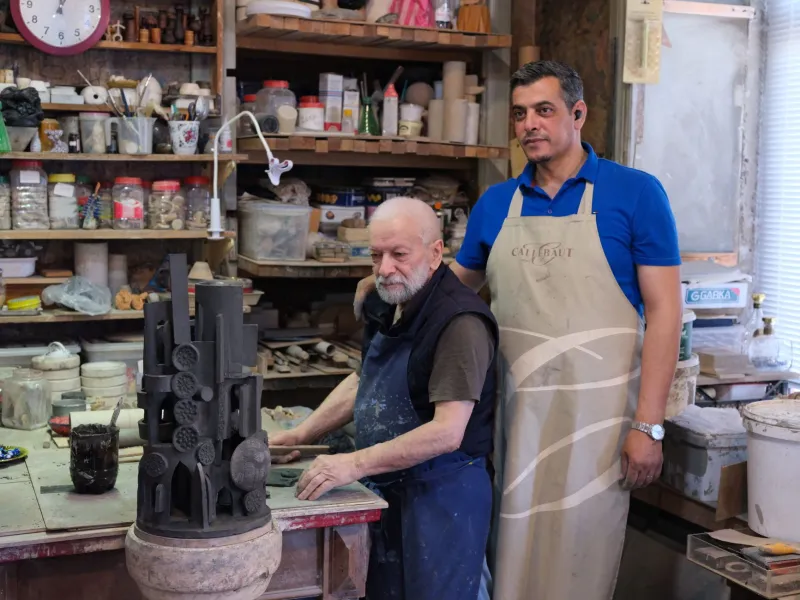
There is a particular moment that many American students of Japanese craft traditions describe with striking consistency. It arrives not at the beginning of their apprenticeship, when everything is unfamiliar, nor at the end, when competence has finally settled into the hands. It arrives somewhere in the middle — often during the second or third year — when the student realizes, with a mixture of frustration and dawning awe, that the master has never once explained what they are doing or why.
This is not negligence. It is, in the most precise sense, the method.
The Architecture of Deliberate Withholding
In workshops across Japan — and increasingly in studios in cities like Portland, Santa Fe, and Brooklyn, where Japanese master artisans have established teaching residencies — the transmission of craft knowledge follows a logic that appears, from the outside, almost perversely resistant to efficiency. A student learning shibori, the ancient resist-dyeing technique that produces its distinctive patterns through folding, binding, and compression, may spend the better part of a year performing the same preparatory gestures before touching dye or fabric in any meaningful way. A metalworking apprentice in the tankin tradition of hand-forging might be tasked for months with nothing more than maintaining the forge, observing the color of heated iron, and learning to hear the difference between a productive strike and a wasted one.
To American sensibilities, shaped by an educational culture that prizes measurable outcomes and linear progress, this can feel like obstruction. Several American students who have trained in Japanese lacquerware — the painstaking urushi tradition that demands dozens of layers applied over months and years — have spoken publicly about early periods of genuine bewilderment. One craftsperson based in Vermont, who spent three years in a Kyoto lacquerware workshop before returning to establish her own studio, recalled that her master rarely offered correction. Instead, he would stand beside her, observe her work in silence, and occasionally reposition a single tool without comment before walking away.
"I kept waiting for the lesson," she has said in interviews. "It took me a very long time to understand that I was already inside it."
Why Shortcuts Are Not Saved Time
The philosophical resistance to modernizing craft pedagogy in Japan is not simply conservatism or institutional inertia. It reflects a deeply considered understanding of how certain categories of knowledge actually transfer between human beings — and which kinds of knowledge cannot survive compression.
Scholars of Japanese aesthetic philosophy have long distinguished between knowledge that can be articulated and knowledge that must be inhabited. The concept of kata — the formalized sequences of movement found in martial arts, theater, and craft traditions alike — represents one of the most sophisticated attempts in any culture to encode embodied wisdom into transmissible form. But kata is not a shortcut. It is a container designed to hold knowledge that resists verbal description, and it requires repetition at a scale that most modern learners find genuinely uncomfortable before it begins to yield its contents.
In shibori instruction, for instance, the precise pressure applied to a fold, the tension maintained across a binding, the way a practitioner reads the resistance of wet cloth — none of these can be adequately conveyed through demonstration alone, much less through written instruction or video. They must be developed through the hands over time, through thousands of repetitions that gradually calibrate the body's intuitions until a kind of automatic knowing takes hold. Masters who have attempted to accelerate this process — to explain rather than embody, to abbreviate rather than repeat — have generally found that what their students produce lacks the quality that distinguishes craft from mere production.
The American Student's Particular Challenge
For Americans entering these traditions, the pedagogical encounter carries a specific cultural weight. The United States has produced extraordinary craft communities, but its educational instincts tend toward transparency: the teacher explains, the student understands, progress is documented and assessed. The idea that a master might deliberately obscure their reasoning, or that confusion might itself be an instructional tool, can feel not merely inefficient but actively disrespectful.
Several American practitioners have described a period of genuine moral discomfort during their apprenticeships — a sense that they were being kept from something they were owed. What many report, looking back, is that this discomfort was itself part of the curriculum. The frustration of not understanding forced them to develop a quality of attention that explanation would have made unnecessary. They learned to watch with an intensity they had never previously applied to watching. They learned to listen to materials — to the sound of lacquer settling, to the behavior of metal under heat — in ways that verbal instruction would have short-circuited.
This is not mysticism. It is, as cognitive researchers studying expertise have increasingly confirmed, a recognizable feature of how deep skill is actually acquired. Explicit instruction is efficient for transmitting explicit knowledge. For knowledge that lives in the body, in perception, in the calibrated response to material and moment, something slower and stranger is required.
What Survives the Transmission
The masters who continue to teach this way are not unaware of the pressures they resist. They understand that their methods are difficult to justify in a marketplace that rewards speed and scalability. Several have spoken with candor about the shrinking number of students willing to commit to the duration that genuine transmission requires, and about the temptation — which they uniformly describe as a form of betrayal — to offer abbreviated versions of their knowledge in order to remain relevant.
What they protect, they will tell you, is not tradition for its own sake. It is the integrity of the knowledge itself. A craft taught quickly is, in a meaningful sense, a different craft — one that has lost the dimensions that cannot survive compression. The lacquerware that emerges from an abbreviated training looks, to the untrained eye, like lacquerware. To the master, it is something else: an object that contains only what can be explained, and is therefore missing most of what matters.
For American students who stay long enough to understand this distinction, the experience tends to be transformative in ways that extend well beyond the workshop. They return to their own lives and practices with a recalibrated relationship to time, to difficulty, and to the meaning of genuine understanding. They have learned, through years of productive confusion, that some of the most important things a person can know are precisely the things that cannot be taught directly — only created, slowly and deliberately, through the conditions that make them possible.
The master withholds the explanation. The student, in time, becomes the answer.