One Bowl, Undivided: How the Ancient Discipline of Chanoyu Is Restoring American Attention
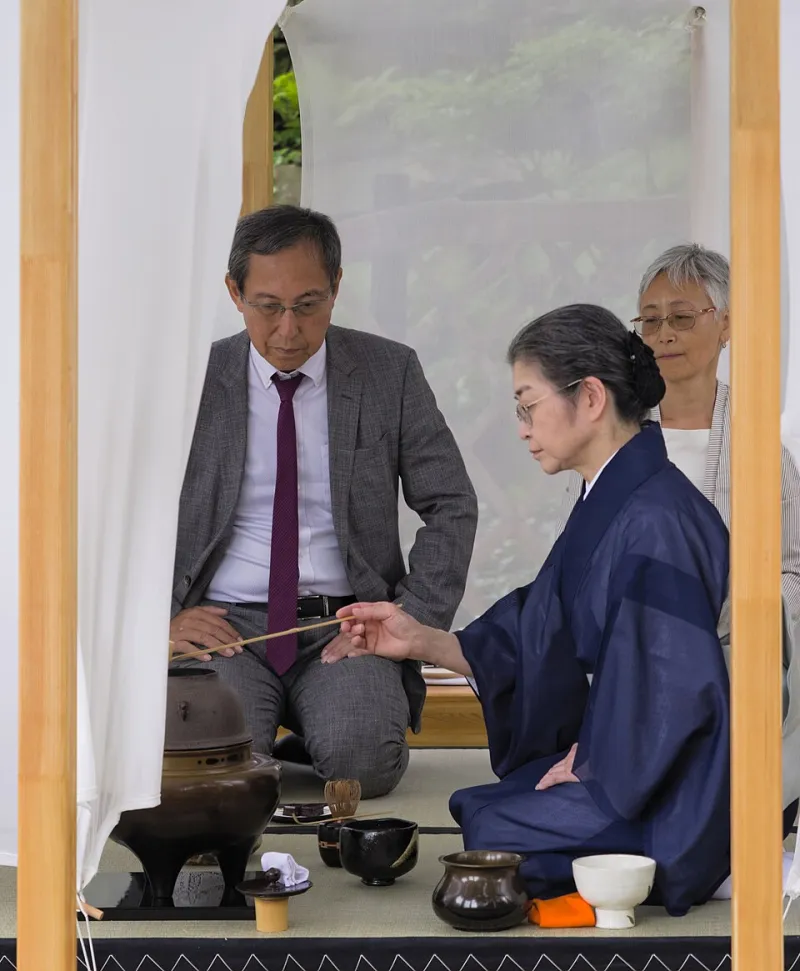
Photo: D-Kuru, CC BY-SA 4.0, via Wikimedia Commons
There is a moment, practitioners say, when the noise stops. Not the ambient noise of a room—those sounds remain—but the interior noise, the relentless scroll of thought and obligation that defines contemporary American life. That moment arrives, reliably, somewhere between lifting the bamboo whisk and watching it trace its first arc through bright green matcha. For a growing number of Americans, this moment has become not a luxury but a necessity.
Chanoyu—literally "hot water for tea," though the practice encompasses a philosophy far broader than any translation can capture—is experiencing a quiet but measurable expansion across the United States. Tea rooms affiliated with Japanese cultural organizations report increased enrollment in introductory workshops. Independent tea masters in cities from Seattle to Atlanta describe waiting lists where none existed five years ago. The timing is not coincidental.
A Practice Built on Presence
To understand why chanoyu resonates so deeply with American anxieties in this particular moment, one must first understand what the practice actually demands. Codified largely through the teachings of Sen no Rikyū in sixteenth-century Japan, chanoyu is governed by principles that resist summary. Wa, kei, sei, jaku—harmony, respect, purity, tranquility—are the four foundational concepts, but these words flatten something that is, at its core, embodied rather than intellectual.
Every gesture in chanoyu carries intention. The angle at which a host folds a silk cloth, the sequence in which utensils are rinsed, the precise positioning of the tea bowl before a guest—none of these details exist for decorative purposes. They exist to anchor attention in the present moment, to make inattention structurally impossible. In this sense, chanoyu is less a performance than a technology of consciousness, one refined across five centuries.
Miranda Hollis, a tea practitioner based in Portland, Oregon, who has studied under a licensed instructor affiliated with the Urasenke school for seven years, describes her first encounter with the practice as disorienting in the most productive sense. "I thought I was learning a kind of etiquette," she says. "What I discovered was that I had no idea how to pay attention to anything. The ceremony made that visible to me, very quickly and without judgment."
The American Context: Overwhelm as Invitation
The United States presents a particular cultural soil in which chanoyu has taken root in unexpected ways. American wellness culture has long pursued presence through a range of modalities—mindfulness meditation apps, breathwork, digital detox retreats—yet many practitioners describe a persistent dissatisfaction, a sense that presence achieved through those means remains fragile, easily dissolved by the next notification. Chanoyu offers something structurally different: presence not as a mental state to be cultivated in isolation, but as a relational and physical discipline embedded in shared space and time.
Dr. James Okafor, a psychologist in Chicago who incorporates cultural arts practices into his therapeutic framework, has observed this distinction among clients who have taken up chanoyu. "What strikes me is the durability of the effect," he notes. "Patients describe a kind of attentional muscle memory that begins to transfer into daily life. The practice trains the nervous system, not just the mind."
This embodied quality matters enormously. Chanoyu requires participants to maintain awareness of their posture, their breath, the temperature of the water, the texture of the tatami, the weight of the bowl in their hands. Distraction is not merely discouraged; it is rendered practically difficult by the density of the practice's demands. For individuals whose attentional lives have been fragmented by years of digital multitasking, this density can feel, paradoxically, like relief.
The Tea Room as Counter-Architecture
The physical environment of chanoyu is itself a form of argument. The traditional tea room, or chashitsu, is deliberately small—often designed for no more than four or five guests—and stripped of ornamentation beyond a single hanging scroll and a flower arrangement chosen to reflect the season. Shoes are removed. Phones, by the customs of most serious practitioners, remain outside. The architecture enforces the philosophy.
In American contexts, tea practitioners have adapted these principles with considerable ingenuity. Some conduct ceremonies in dedicated studio spaces; others use converted living rooms, community center halls, or, in warmer months, outdoor gardens. What remains consistent is the intentional creation of a threshold—a moment of transition that signals to participants that ordinary time has been suspended.
Naomi Tanaka, who leads tea gatherings at a Japanese cultural center in Los Angeles, describes this threshold as the most important element she preserves in her adapted practice. "When someone crosses into the tea space, something shifts in them," she observes. "You can see it happen. The shoulders drop. The eyes soften. That transition is doing something that hours of scrolling through wellness content cannot do."
Learning Slowly, Learning Deeply
For those drawn to explore chanoyu seriously, the path is one of extended study. Formal instruction typically spans years, even decades, and proceeds through a structured curriculum of increasingly complex procedures. This temporal depth is, for many American students, both the greatest challenge and the most transformative aspect of the practice.
American culture maintains a complicated relationship with slowness. Efficiency is valorized; mastery is admired but often expected to arrive quickly. Chanoyu dismantles these expectations methodically. Students practice the same foundational movements hundreds of times before advancing. The repetition is not tedious, practitioners insist, but revelatory—each iteration offering a slightly different experience of the same gesture, a subtly deeper understanding of what presence actually requires.
Hollis, reflecting on her seven years of study, puts it plainly: "I am still a beginner. That used to frustrate me. Now I understand it as one of the most honest things the practice has given me."
An Ancient Discipline for an Urgent Moment
Chanoyu does not promise transformation in a weekend workshop, and reputable teachers are careful to communicate this honestly. What it does offer—and what American practitioners describe receiving, incrementally, over time—is a framework for attention that is both ancient and urgently contemporary. In a cultural moment defined by the proliferation of stimulation and the erosion of sustained focus, the tea room stands as a form of counter-proposal: a space where one bowl, one moment, and one exchange of genuine hospitality constitute a complete and sufficient world.
For those willing to accept the invitation on its own terms, the practice asks very little and offers, its students suggest, something close to everything.