Gold in the Fracture: How Kintsugi Is Changing the Way Americans Understand Repair
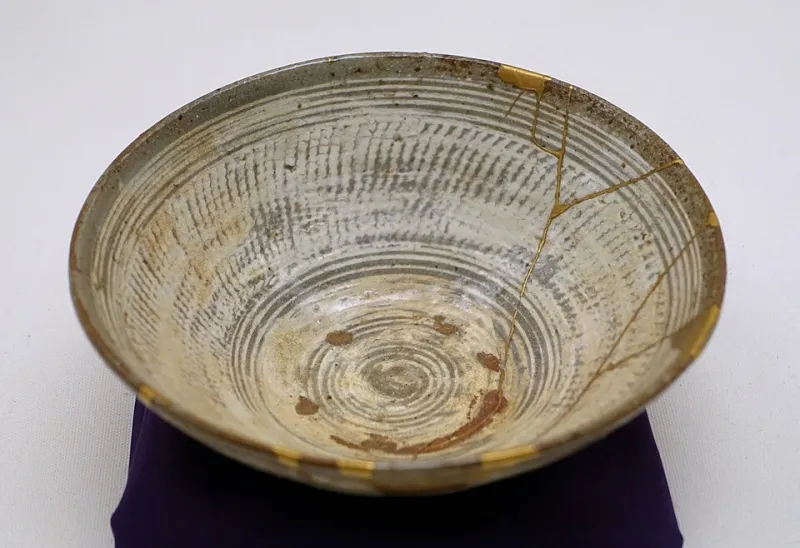
Photo: Daderot, CC0, via Wikimedia Commons
A ceramic bowl shatters. In most American households, the story ends there—a brief moment of frustration, a trip to the trash, a replacement ordered online by evening. The broken object is evidence of failure, an inconvenience to be resolved through disposal. Kintsugi proposes an entirely different ending to that story, and increasingly, Americans are listening.
Derived from the Japanese words for "golden" (kin) and "to join" (tsugi), kintsugi is the practice of repairing fractured ceramics using urushi lacquer mixed with powdered gold, silver, or platinum. The repair is not concealed. It is illuminated. The seams of breakage become the most visually prominent element of the restored object, transforming damage into a defining feature rather than a defect to be disguised. The philosophy embedded in this technique—that an object's history of breaking and mending constitutes part of its beauty—has resonated with Americans in ways that extend well beyond the ceramics workshop.
A Technique with Deep Roots
The origins of kintsugi are debated among scholars, but the practice is generally traced to Japan's Muromachi period, roughly the fifteenth century, with its philosophical elaboration developing in close conversation with the aesthetics of wabi-sabi—the Japanese sensibility that finds beauty in impermanence, imperfection, and incompleteness. Where Western artistic traditions have often sought to restore damaged objects to the appearance of wholeness, kintsugi embraced the opposite impulse: the break, honestly acknowledged and carefully honored, becomes the object's most meaningful feature.
For centuries, kintsugi remained largely within the world of Japanese ceramics and the aesthetic discourse surrounding the tea ceremony, where imperfect and repaired vessels have long been prized over flawless ones. Its arrival in American consciousness has been more recent, accelerated by social media imagery, museum exhibitions, and a growing popular appetite for philosophical frameworks that address loss, resilience, and the meaning of imperfection.
From Studio to Therapy Room
What distinguishes kintsugi's American trajectory is the degree to which it has migrated from the artisan's studio into spaces of psychological and communal healing. Therapists, grief counselors, social workers, and trauma-informed educators have adopted kintsugi workshops as experiential tools, recognizing in the practice a rare capacity to make abstract emotional concepts tangible.
Dr. Priya Mehta, a licensed clinical social worker in Denver who facilitates kintsugi workshops for adults navigating grief and life transition, describes the effect on participants as consistently striking. "There is something that happens when someone holds the pieces of a broken object and is told that the break itself is not a problem to be hidden," she explains. "For people who have been carrying shame about their own fractures—divorce, illness, loss—that reframing can be genuinely transformative."
The workshops Mehta facilitates do not require participants to master traditional urushi lacquer technique, which demands years of study and involves materials that require careful handling. Instead, adapted methods using food-safe adhesives and gold mica powder allow participants to engage with the philosophical and emotional dimensions of kintsugi within a single session. Purists within the Japanese ceramics tradition are sometimes critical of these adaptations, and the tension between accessible approximation and authentic practice is one that responsible facilitators acknowledge openly.
Yet the therapeutic value of even an adapted encounter with kintsugi's core principles appears to be substantive. Participants in Mehta's workshops frequently describe the experience as clarifying—a physical metaphor that organizes emotions that had previously resisted articulation.
A Counter-Narrative to Consumer Culture
Beyond the therapy room, kintsugi has acquired resonance as a form of cultural critique. American consumer culture is organized, in significant part, around the premise of obsolescence: objects break, and broken objects are replaced. This logic has extended, critics argue, into domains far beyond material goods—into relationships, careers, and self-conception. The kintsugi framework challenges this premise at its foundation.
Amanda Reyes, a ceramicist and educator based in Brooklyn who teaches kintsugi technique in both its traditional and adapted forms, frames the practice explicitly as an act of resistance. "We live in a culture that treats imperfection as a problem and repair as a last resort," she says. "Kintsugi says the opposite: repair is not a compromise. It is a form of devotion. It is how an object becomes more itself, not less."
Reyes is careful to situate kintsugi within its Japanese cultural context when she teaches, emphasizing the wabi-sabi aesthetic tradition and the historical relationship between the practice and the tea ceremony. She considers this contextualization inseparable from the practice's integrity. "You cannot borrow the philosophy without honoring where it comes from," she says. "The meaning and the history are not separate things."
The Artist's Eye on the Seam
For working artists, kintsugi has opened aesthetic and conceptual territory that extends beyond restoration into original creation. A number of American ceramicists have begun intentionally breaking and rejoining their own work, using the kintsugi method as a generative rather than a remedial technique—a way of introducing history, narrative, and visible time into objects that might otherwise appear static.
This development represents a significant departure from the practice's traditional function, and it raises genuine questions about cultural adaptation and ownership that the American arts community is navigating with varying degrees of thoughtfulness. At its best, this creative engagement deepens American practitioners' understanding of the Japanese aesthetic values from which kintsugi emerged. At its least careful, it risks reducing a philosophically rich tradition to a surface aesthetic—gold lines on pottery, divorced from the sensibility that gives them meaning.
What the Broken Bowl Teaches
Kintsugi endures as a practice—and flourishes as a philosophy—because it addresses something that purely intellectual frameworks cannot: the embodied experience of holding something that was broken and has been, through patient effort, made whole again. Not identical to what it was. Not unmarked. But whole in a new and more honest way.
For Americans navigating a cultural moment saturated with both material abundance and a pervasive sense of fragility, the broken bowl reseamed in gold offers something quietly radical. It suggests that the record of damage need not be erased to be resolved—that repair, undertaken with care and intention, is not a diminishment but an act of profound respect for what something has endured.
The fracture, filled with gold, catches the light. The bowl holds.